
Entende o contexto
Lê a operação, o cliente e o histórico antes de propor qualquer coisa.
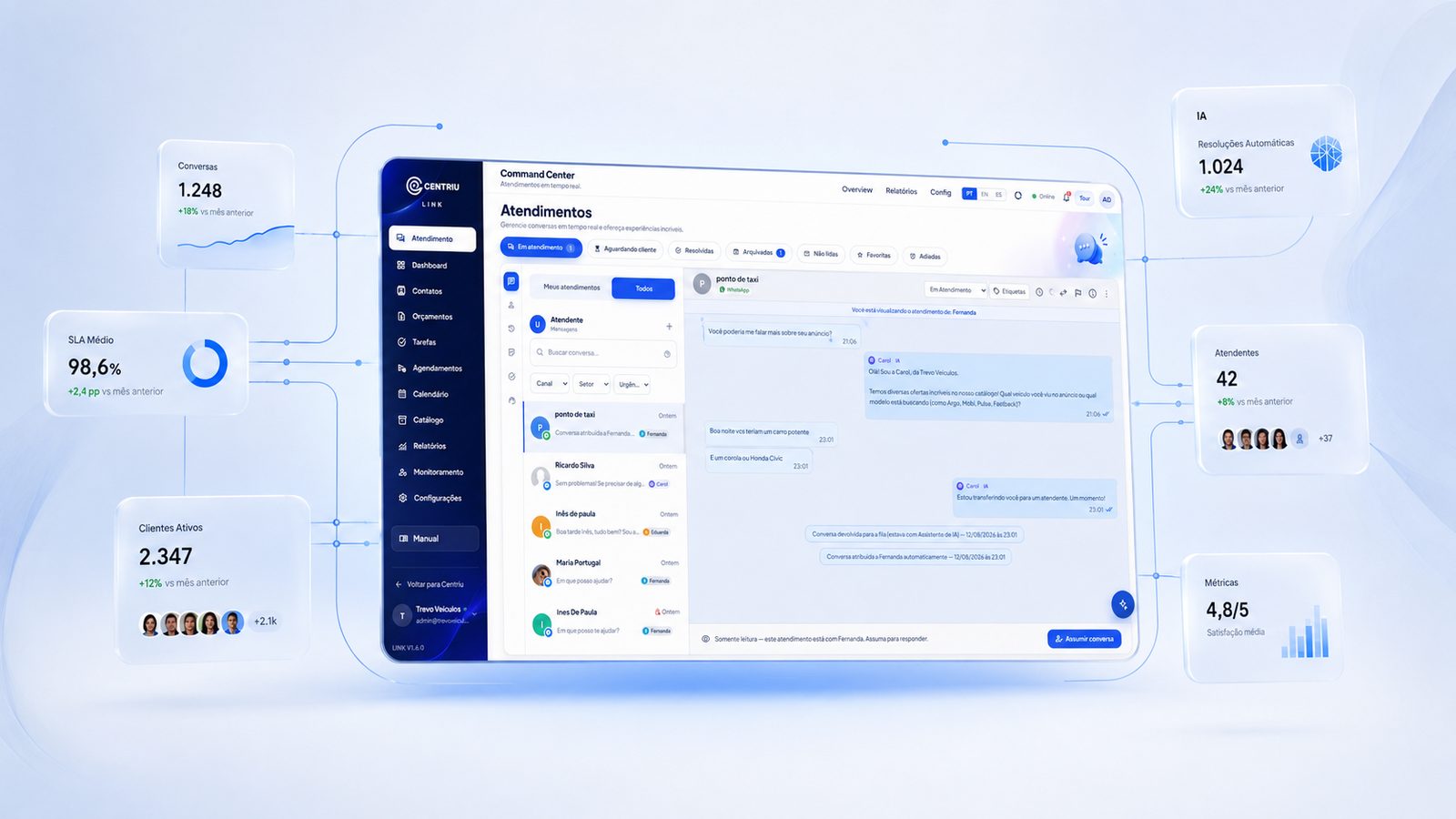
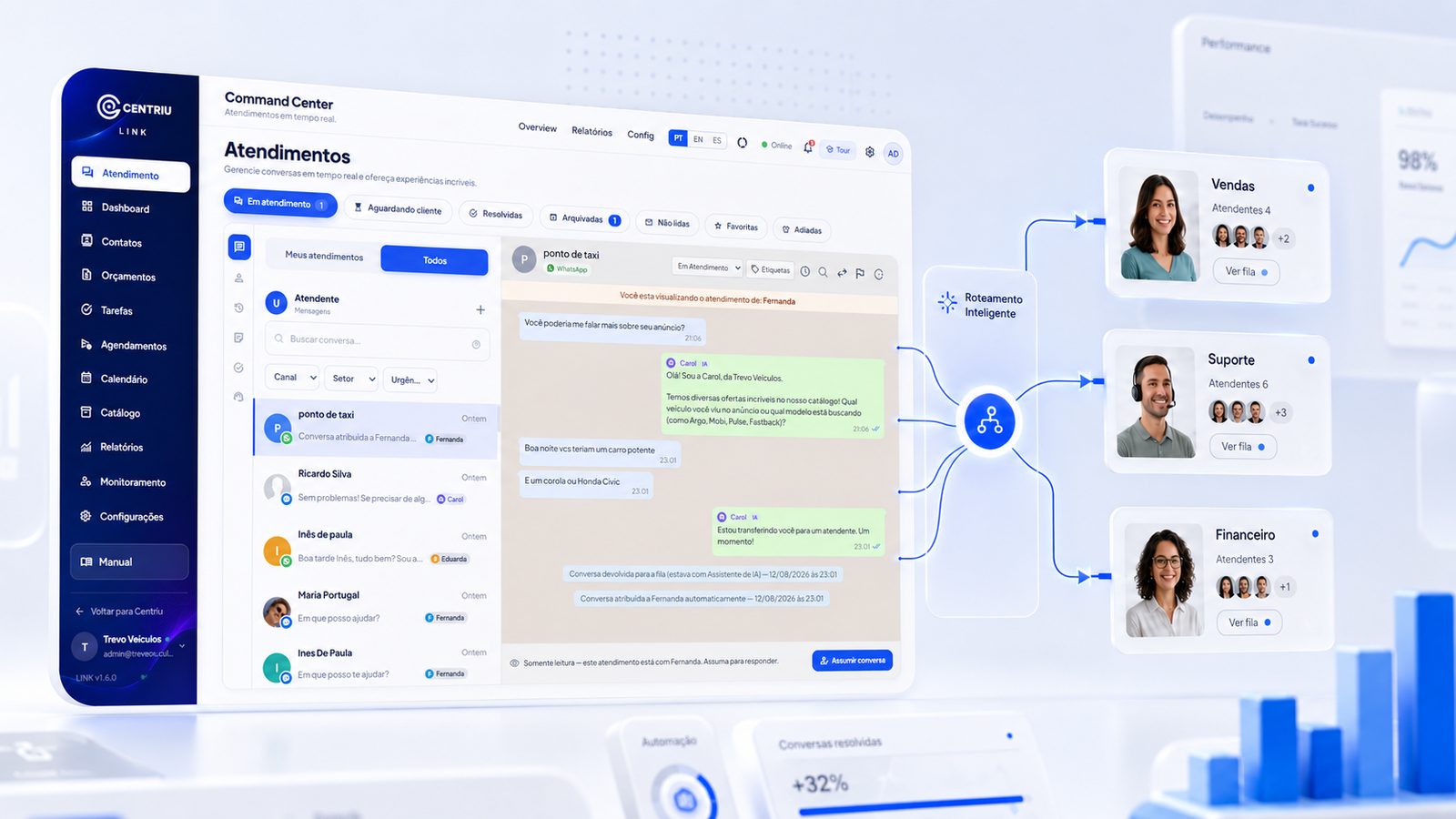
Vendas, marketing, atendimento, operação, financeiro e inteligência trabalhando sobre o mesmo contexto — para sua empresa ganhar escala sem perder controle.
Sua empresa inteira. Uma operação. IA trabalhando.
Para empresas de qualquer setor que querem crescer com estrutura, controle e inteligência.
Painel ilustrativo do Sistema Centriu com sete frentes trabalhando: atendimento, comercial, operação, agentes, inteligência, conteúdo e marketing. Cada frente mostra o trabalho concluído ou o próximo passo.
Representação ilustrativa do trabalho em execução
Não é falta de ferramenta. É que cada ferramenta resolve um pedaço, e ninguém é dono do todo. O custo disso não aparece numa fatura — aparece no mês seguinte.
Sistemas que não se falam
O mesmo dado é digitado de novo — e cada cópia conta uma história diferente.
Dados duplicados
Ninguém sabe qual versão é a verdadeira na hora de decidir.
Conversas perdidas
O cliente repete o contexto a cada canal e a cada pessoa.
Tarefas espalhadas
O trabalho vive em planilhas, mensagens e na memória de alguém.
Decisões sem contexto
A escolha é feita com o recorte que estava à mão, não com o que importava.
Automações desconectadas
Cada ferramenta automatiza um pedaço e ninguém enxerga o todo.
Nenhum desses problemas se resolve comprando mais um software. Eles se resolvem quando a operação inteira passa a trabalhar sobre o mesmo contexto.
A Centriu não é uma coleção de produtos. É uma plataforma em que clientes, áreas e agentes leem e escrevem no mesmo lugar.
Cliente 360
Um contexto, não vários cadastros
Cada conversa, tarefa, campanha, cobrança e decisão fica ligada ao cliente e à operação — não a um sistema isolado.
As áreas abaixo são partes da mesma operação, não produtos separados. Elas compartilham conta, permissões e histórico.
A inteligência artificial da Centriu participa da operação: entende contexto, prepara trabalho, executa rotinas e pede aprovação quando importa.
Lê a operação, o cliente e o histórico antes de propor qualquer coisa.
Redige, organiza, calcula e deixa pronto para revisão humana.
Roda o que é repetitivo dentro dos limites definidos pela empresa.
Cruza áreas, identifica prioridade e mostra o motivo da recomendação.
O que é sensível passa por uma pessoa antes de valer. Sem exceção silenciosa.
Registra o que aconteceu e usa o resultado para melhorar a próxima decisão.
Uma plataforma, várias frentes de trabalho. Tudo no mesmo contexto, com a IA participando do que dá para acelerar.
CRM, pipeline, oportunidades, propostas, follow-up e automações.
WhatsApp, Instagram, Messenger, chat do site e e-mail no mesmo contexto.
Tarefas, responsáveis, prazos, aprovações, agenda e capacidade.
Contas, cobranças, caixa, fiscal, margem, IR, orçamento e inteligência econômica.
Planejar, produzir, aprovar, publicar e medir conteúdo e campanhas.
Painéis, alertas, previsões, recomendações e leitura executiva.
Rotinas executadas continuamente pela IA com controle e aprovação.
Diagnóstico, estratégia, transformação, acompanhamento e especialistas.
A Centriu faz sentido quando o volume aumenta e a estrutura precisa acompanhar. Não é sobre setor nem tamanho: é sobre a operação conseguir sustentar o próximo estágio.
As vendas crescem, mas o processo não acompanha.
As áreas trabalham separadas e o cliente sente.
A operação depende de pessoas específicas.
O financeiro ficou complexo e o caixa perde visibilidade.
O atendimento cresce em volume e em canais.
A IA entra sem contexto, controle ou histórico.
Se a empresa ainda não começou a crescer, a Centriu também ajuda a preparar a estrutura para o primeiro salto.
Ver a Centriu funcionandoA Centriu combina tecnologia, inteligência, método e acompanhamento. A consultoria diagnostica, desenha, implanta e acompanha — com evidências, não com apresentação.
Diagnóstico e imersão na operação
Estratégia e prioridades
Roadmap de transformação
Desenho da arquitetura operacional
Implantação conduzida
Acompanhamento com evidências
Benchmarking e leitura de mercado
Especialistas, rede e inteligência coletiva
Uma conversa para entender onde a sua operação perde tempo, dinheiro ou capacidade — e o que a Centriu faria primeiro.
problema
Centriu's internal financial specialist agent used to see only a nightly-synced mirror table. It could not see Gauge's actual 120-table financial core. A dedicated migration gave it 11 direct tools instead. 6 tools are read-only. These include a quick financial overview, invoice listing, overdue-account aging, dunning-sequence status, issued documents, and a reporting view. 5 tools can write. These include creating a draft invoice, registering a payment through the product's own atomic settlement routine, logging a payable, registering a supplier, and setting up a recurring subscription. Every write tool states its own boundary in the same catalog entry an agent reads before calling it. Issuing a real charge in Asaas is not part of this agent toolset. Approving a payment is not part of this agent toolset. Configuring the dunning sequence is not part of this agent toolset. Reconciling a bank statement is not part of this agent toolset. Closing a financial period is not part of this agent toolset. The agent is explicitly instructed it never negotiates a discount or a waiver. It only prepares the case for a person to decide.
An internal AI assistant is only as useful as the data it can actually see. A synced mirror table, refreshed once a day, tells an agent what was true yesterday morning. It does not tell what is true right now. A financial specialist that can only read a copy of one narrow slice of the ledger cannot answer a same-day question about total receivables. In this case, it was just the client-facing boleto mirror. It cannot draft an invoice. It cannot register a payment. Every one of those requires reaching the actual source of truth, not its reflection.
An internal AI assistant is only as useful as the data it can actually see. A synced mirror table, refreshed once a day, tells an agent what was true yesterday morning. It does not tell what is true right now. A financial specialist that can only read a copy of one narrow slice of the ledger cannot answer a same-day question about total receivables. In this case, it was just the client-facing boleto mirror. It cannot draft an invoice. It cannot register a payment. Every one of those requires reaching the actual source of truth, not its reflection.
The starting census was recorded directly in the migration's own header comment. It was blunt about the gap. Gauge has 120 tables. This includes invoices, boletos and Pix via Asaas, dunning, subscriptions, reconciliation, cash position, and tax. Before this migration, it had zero agent tools. The financial specialist agent could only operate `client_boletos`. This was a mirror table inside Axis. It was fed by a once-daily 05:00 sync. The actual source system was invisible to it.
Eleven named tools replace that gap. Each has an explicit read (`le`) or write (`escreve`) classification. This is recorded in the same catalog row an agent reads before calling it. The six read tools cover a quick financial panel. This panel shows receivables due and overdue, payables due, the next 7 days both ways, this month's collections, active subscription MRR, open issued documents, and whether the dunning sequence is even turned on. They also cover invoice listing by status or client. They show an aging view of who owes what and how many dunning emails they've already received. They show the dunning sequence's own state. They show issued fiscal documents. They show a reporting view combining aging with the current month's totals.
The five write tools are deliberately narrow. Creating an invoice produces a Pending record only. Issuing the real boleto or Pix charge against Asaas is a separate, human step inside the app. The tool's own description states this explicitly. Registering a payment does not write to the invoice's status column directly. It calls the product's own atomic settlement routine (`gauge_receivable_settle`). This is the same routine a person uses from the app. It handles a partial payment by carrying the remainder as balance. It handles an overpayment as credit. It does not treat them as two disconnected numbers. That routine's own authorization check requires the calling identity to be a member of the organization. The agent's own database user is deliberately NOT a member, by design. So, the settlement tool borrows the organization owner's identity for the duration of that one transaction only. It does this via a session-local `set_config` call. It records the agent's own authorship in the settlement's notes field. The migration's own comment names this exact pattern as a reuse of an already-established design. This was Orbit's own stage-move mechanism, from an earlier migration. It is a deliberate, repeated approach to the same underlying problem. It is not a one-off workaround invented for Gauge alone. Logging a payable, registering a supplier (deduplicated by name), and creating a recurring subscription round out the write side. The subscription tool registers the subscription only.
Every boundary is stated twice, not once. It is in the tool catalog's own `contrato` text an agent reads before calling it. It is again in the specialist agent's own rewritten brief. This brief lists, in plain language, exactly what stays human. This includes issuing a real charge. It includes approving or paying an expense. It includes turning on or configuring the dunning sequence. It includes reconciling a bank statement. It includes closing a financial period. It adds a rule with no exception. The agent never negotiates a discount, a waiver, or an extended deadline on its own authority. It prepares the case. This includes how much, since when, and what has already been tried. It hands it to the partners.
11 named Gauge tools for the internal financial specialist agent. 6 are read-only. 5 can write. Each is explicitly classified in the same catalog entry the agent reads before calling it.
Payment settlement is routed through the product's own atomic routine (`gauge_receivable_settle`). It is not a direct status-column write. Partial payments carry as balance. Overpayments carry as credit.
A session-scoped identity borrow lets the agent settle a receivable. It uses the organization owner's identity for one transaction only. This lets it use logic that requires organization membership. It does not make the agent's own database user a member. This is the same pattern already used for Orbit's own agent-driven stage moves.
A hard, named boundary is applied consistently. This is across both the tool catalog and the agent's own brief. Real charge issuance is left out of this agent toolset. Payment approval is left out. Dunning configuration is left out. Bank reconciliation is left out. Period close is left out.
An explicit, unconditional rule states that the agent never negotiates a discount, waiver or deadline extension. It prepares the case. It hands it to a person.
A dedicated aging tool is built specifically for collections. It shows days overdue. It shows how many dunning emails have already been sent. This ensures a collections conversation starts from an accurate picture, not a guess.
The financial specialist agent can now answer a same-day question about receivables. It can answer about payables. It can answer about an overdue account. It gets this from the actual source of truth. It does not use a once-a-day mirror. It can act on straightforward, well-defined tasks. This includes drafting an invoice. It includes logging a payable. It includes registering a known payment. It can do this without a person doing the manual entry. At the same time, every action with a real external effect stays exactly where it was before. This includes money actually moving out via a real charge. It includes a payment actually approved. These actions stay with a person, inside the app, deciding.
The financial specialist agent can now answer a same-day question about receivables. It can answer about payables. It can answer about an overdue account. It gets this from the actual source of truth. It does not use a once-a-day mirror. It can act on straightforward, well-defined tasks. This includes drafting an invoice. It includes logging a payable. It includes registering a known payment. It can do this without a person doing the manual entry. At the same time, every action with a real external effect stays exactly where it was before. This includes money actually moving out via a real charge. It includes a payment actually approved. These actions stay with a person, inside the app, deciding.
A client pays an invoice by Pix outside the automatic Asaas webhook flow. For example, it could be a direct bank transfer the team learns about by message. Someone asks the financial agent to register it. The agent looks up the invoice. It confirms it isn't already marked Paid. It calls the settlement tool with the amount and date. This runs through the same atomic routine the app itself uses. So, a partial amount is handled as a partial payment. It does not silently mark the whole invoice settled.
Only a once-daily synced mirror of client-facing boleto records inside Axis. The actual Gauge financial core has 120 tables. It had zero agent tools before this migration.
It can create a Pending invoice record. But issuing the real boleto or Pix charge in Asaas is a separate, human-only step inside the app.
It calls the same atomic settlement routine (`gauge_receivable_settle`) a person uses from the app. Partial payments carry as balance. Overpayments carry as credit. This is exactly as they would from a manual entry.
No. It is explicitly instructed to never negotiate a discount, waiver or extended deadline on its own authority. It prepares the case. It hands it to a person.
No. The underlying settlement routine requires organization membership. So the tool borrows the organization owner's identity for that one transaction only. This reuses a pattern already established for Orbit's own agent-driven actions.
It is sold by subscription with a published starting price. Exact current values are on the central pricing page.
Centriu's internal financial specialist agent used to see only a nightly-synced mirror table. It could not see Gauge's actual 120-table financial core. A dedicated migration gave it 11 direct tools instead. 6 tools are read-only. These include a quick financial overview, invoice listing, overdue-account aging, dunning-sequence status, issued documents, and a reporting view. 5 tools can write. These include creating a draft invoice, registering a payment through the product's own atomic settlement routine, logging a payable, registering a supplier, and setting up a recurring subscription. Every write tool states its own boundary in the same catalog entry an agent reads before calling it. Issuing a real charge in Asaas is not part of this agent toolset. Approving a payment is not part of this agent toolset. Configuring the dunning sequence is not part of this agent toolset. Reconciling a bank statement is not part of this agent toolset. Closing a financial period is not part of this agent toolset. The agent is explicitly instructed it never negotiates a discount or a waiver. It only prepares the case for a person to decide.