
Entende o contexto
Lê a operação, o cliente e o histórico antes de propor qualquer coisa.
Vendas, marketing, atendimento, operação, financeiro e inteligência trabalhando sobre o mesmo contexto — para sua empresa ganhar escala sem perder controle.
Sua empresa inteira. Uma operação. IA trabalhando.
Para empresas de qualquer setor que querem crescer com estrutura, controle e inteligência.
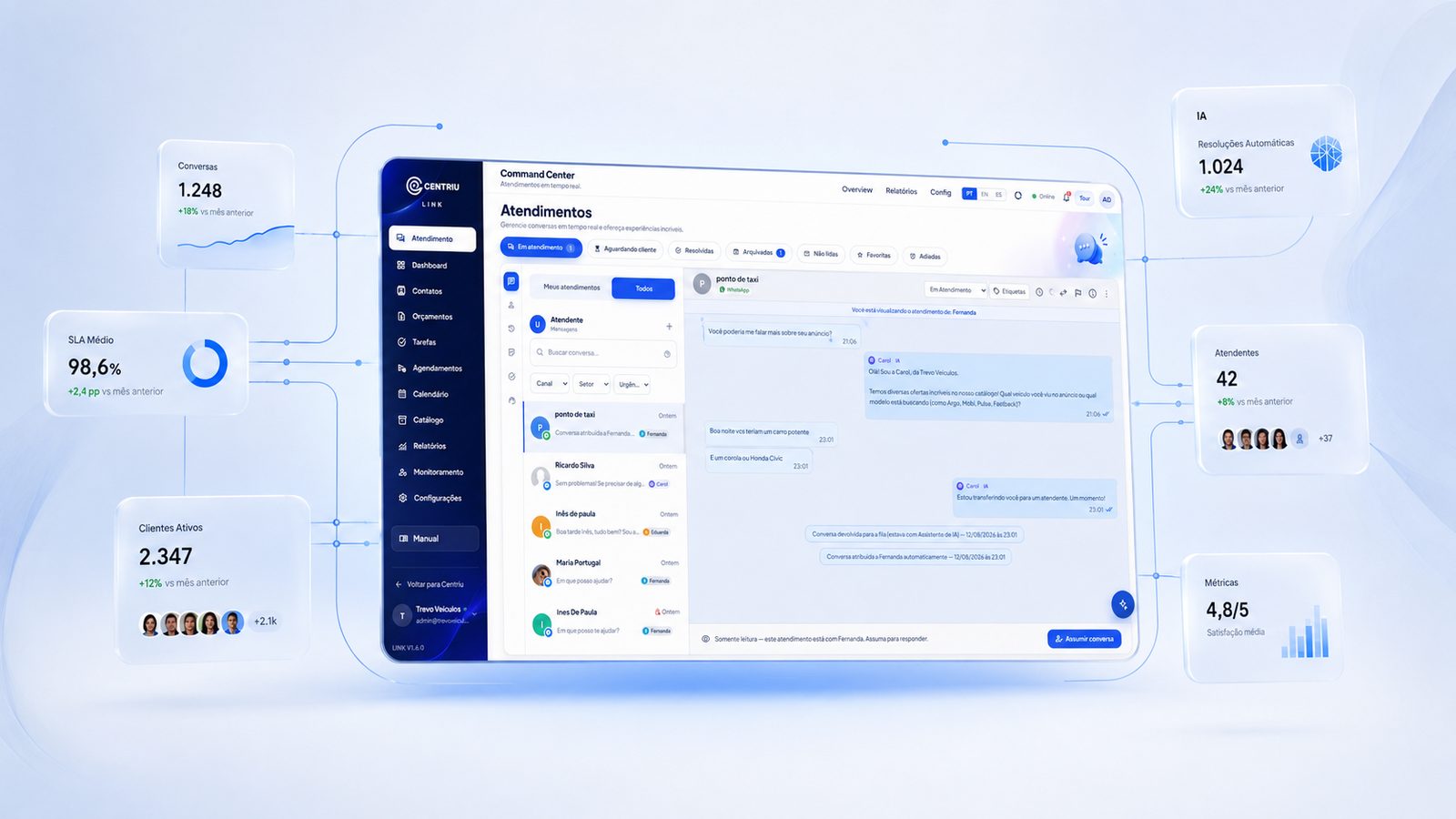
Painel ilustrativo do Sistema Centriu com sete frentes trabalhando: atendimento, comercial, operação, agentes, inteligência, conteúdo e marketing. Cada frente mostra o trabalho concluído ou o próximo passo.
Representação ilustrativa do trabalho em execução
Não é falta de ferramenta. É que cada ferramenta resolve um pedaço, e ninguém é dono do todo. O custo disso não aparece numa fatura — aparece no mês seguinte.
Sistemas que não se falam
O mesmo dado é digitado de novo — e cada cópia conta uma história diferente.
Dados duplicados
Ninguém sabe qual versão é a verdadeira na hora de decidir.
Conversas perdidas
O cliente repete o contexto a cada canal e a cada pessoa.
Tarefas espalhadas
O trabalho vive em planilhas, mensagens e na memória de alguém.
Decisões sem contexto
A escolha é feita com o recorte que estava à mão, não com o que importava.
Automações desconectadas
Cada ferramenta automatiza um pedaço e ninguém enxerga o todo.
Nenhum desses problemas se resolve comprando mais um software. Eles se resolvem quando a operação inteira passa a trabalhar sobre o mesmo contexto.
A Centriu não é uma coleção de produtos. É uma plataforma em que clientes, áreas e agentes leem e escrevem no mesmo lugar.
Cliente 360
Um contexto, não vários cadastros
Cada conversa, tarefa, campanha, cobrança e decisão fica ligada ao cliente e à operação — não a um sistema isolado.
As áreas abaixo são partes da mesma operação, não produtos separados. Elas compartilham conta, permissões e histórico.
A inteligência artificial da Centriu participa da operação: entende contexto, prepara trabalho, executa rotinas e pede aprovação quando importa.
Lê a operação, o cliente e o histórico antes de propor qualquer coisa.
Redige, organiza, calcula e deixa pronto para revisão humana.
Roda o que é repetitivo dentro dos limites definidos pela empresa.
Cruza áreas, identifica prioridade e mostra o motivo da recomendação.
O que é sensível passa por uma pessoa antes de valer. Sem exceção silenciosa.
Registra o que aconteceu e usa o resultado para melhorar a próxima decisão.
Uma plataforma, várias frentes de trabalho. Tudo no mesmo contexto, com a IA participando do que dá para acelerar.
CRM, pipeline, oportunidades, propostas, follow-up e automações.
WhatsApp, Instagram, Messenger, chat do site e e-mail no mesmo contexto.
Tarefas, responsáveis, prazos, aprovações, agenda e capacidade.
Contas, cobranças, caixa, fiscal, margem, IR, orçamento e inteligência econômica.
Planejar, produzir, aprovar, publicar e medir conteúdo e campanhas.
Painéis, alertas, previsões, recomendações e leitura executiva.
Rotinas executadas continuamente pela IA com controle e aprovação.
Diagnóstico, estratégia, transformação, acompanhamento e especialistas.
A Centriu faz sentido quando o volume aumenta e a estrutura precisa acompanhar. Não é sobre setor nem tamanho: é sobre a operação conseguir sustentar o próximo estágio.
As vendas crescem, mas o processo não acompanha.
As áreas trabalham separadas e o cliente sente.
A operação depende de pessoas específicas.
O financeiro ficou complexo e o caixa perde visibilidade.
O atendimento cresce em volume e em canais.
A IA entra sem contexto, controle ou histórico.
Se a empresa ainda não começou a crescer, a Centriu também ajuda a preparar a estrutura para o primeiro salto.
Ver a Centriu funcionandoA Centriu combina tecnologia, inteligência, método e acompanhamento. A consultoria diagnostica, desenha, implanta e acompanha — com evidências, não com apresentação.
Diagnóstico e imersão na operação
Estratégia e prioridades
Roadmap de transformação
Desenho da arquitetura operacional
Implantação conduzida
Acompanhamento com evidências
Benchmarking e leitura de mercado
Especialistas, rede e inteligência coletiva
Uma conversa para entender onde a sua operação perde tempo, dinheiro ou capacidade — e o que a Centriu faria primeiro.
problema
An AI agent can end up with more access than intended. This is rarely one bad decision. It is usually many small grants that nobody added together. Centriu TrustOps does not add them. An agent's effective permission is computed as the INTERSECTION of its identity scopes, credential scopes, asset scopes, and system scopes when declared. It is never their union. Any explicit policy denial is subtracted afterward. Every authorization check fails closed. Every agent moves through a 14-state lifecycle with a guarded transition table. It cannot reach production without a registered owner. A compromised agent can never go straight back to active. It can only go through quarantine, a completed investigation, and freshly issued credentials.
Give an AI agent an identity, a credential to authenticate with, and access to a couple of internal systems. Each of those three grants gets configured by a different person at a different time. This is usually for a specific, narrow reason. None of those grants is wrong on its own. The risk appears when a system ASSUMES that having any one of the three is enough. A valid credential does not mean the identity is trustworthy. Access to a system does not mean the credential authorizes every action on it. That assumption lets partial, reasonable grants combine into an access level nobody approved. This is exactly the failure mode a governance layer needs to refuse by construction rather than catch after the fact.
Give an AI agent an identity, a credential to authenticate with, and access to a couple of internal systems. Each of those three grants gets configured by a different person at a different time. This is usually for a specific, narrow reason. None of those grants is wrong on its own. The risk appears when a system ASSUMES that having any one of the three is enough. A valid credential does not mean the identity is trustworthy. Access to a system does not mean the credential authorizes every action on it. That assumption lets partial, reasonable grants combine into an access level nobody approved. This is exactly the failure mode a governance layer needs to refuse by construction rather than catch after the fact.
Every agent carries four permission layers. These are identity scopes, credential scopes, asset scopes, and system scopes when declared. Its effective permission is their INTERSECTION. This is computed fresh on every check. It is never cached as a standing union. An empty layer means no access from that source (fail-closed). There is one deliberate exception: an empty system-scope layer is read as "the system adds no further restriction." It is not read as "the system grants everything." Explicit policy denials are then subtracted from whatever remains. That effective set is only the first gate. A specific request also has to pass a contextual layer. This checks that the identity can currently authenticate. It checks that the credential itself is valid. It checks that the agent's lifecycle state currently allows operation. It checks that the environment, purpose, and time window match what was approved for this agent. For scopes flagged as requiring it, a live human approval must exist right now. This is even if the scope is technically inside the effective set. Underneath all of that sits a 14-state lifecycle machine. The states are: requested, in development, in test, in homologation, awaiting evaluation, approved, approved with restrictions, active, suspended, quarantined, compromised, discontinuing, discontinued, archived. The absence of a listed transition is itself a denial. An agent cannot skip from "in development" to "active" because no such transition exists in the table. Two guards sit outside the table entirely. An agent cannot enter production without an owner on record. An agent marked compromised can only be moved out of that state into quarantine. This is only once an investigation is marked complete and new credentials have been issued. Reactivating straight to active is not a legal transition from compromised under any condition.
Effective permission computed as the intersection of identity, credential, and asset scopes. This includes system scopes when declared. It is never their union. Explicit policy denials are always subtracted afterward.
A fail-closed authorization chain checking, in order: identity can authenticate, credential is usable, lifecycle state allows operation, environment is on the approved list, purpose is on the approved list when one is declared, the request falls inside the approved time window, the scope is in the effective set or covered by a narrow, explicitly valid exception. For scopes marked as requiring it, a live human approval currently exists.
A 14-state agent lifecycle. The states are: requested, in development, in test, in homologation, awaiting evaluation, approved, approved with restrictions, active, suspended, quarantined, compromised, discontinuing, discontinued, archived. It has a fixed transition table. An unlisted transition is a denial by default.
A hard guard requiring a registered owner before any agent can enter production.
A hard guard on the compromised state. Exit is only possible into quarantine. This is only with a completed investigation and freshly issued credentials. There is never a direct return to active.
Automatic downgrade from active to approved-with-restrictions when a scheduled access review lapses past its due date.
Credential typing and status tracking. This includes documented rotation reasons. A credential's own state (valid, expired, revoked) is checked independently of the identity that holds it.
Session status and end-reason tracking. This is separate from the credential and identity layers.
Critical scopes flagged and monitored distinctly. This is even once authorized, rather than treated the same as any other granted scope.
The structural change is that "does this agent have access" stops being answerable by checking any single layer. It becomes a question that requires every layer to agree, every time. Partial grants stop silently combining into something nobody approved. A compromised agent cannot quietly return to normal operation just because one person decides it looks fine now. A lapsed review has a real, automatic consequence — a downgrade. This is rather than depending on someone noticing the date. Centriu attaches no figure to what that prevents. It depends entirely on how many agents, credentials, and systems an organization is governing.
The structural change is that "does this agent have access" stops being answerable by checking any single layer. It becomes a question that requires every layer to agree, every time. Partial grants stop silently combining into something nobody approved. A compromised agent cannot quietly return to normal operation just because one person decides it looks fine now. A lapsed review has a real, automatic consequence — a downgrade. This is rather than depending on someone noticing the date. Centriu attaches no figure to what that prevents. It depends entirely on how many agents, credentials, and systems an organization is governing.
A security review flags unusual behavior from a customer-support AI agent. It marks its identity as compromised. Under the lifecycle table, compromised has exactly two legal exits: quarantine or discontinuing. The team quarantines it. From quarantine, the table narrows the options again. The agent cannot return to active. The guard requires an investigation to be marked complete and new credentials to have been issued first. The investigation takes two days. Once it closes and a fresh credential is generated, the transition back to active becomes legal. The agent resumes work.
Separately, one of the agent's scopes was already flagged as requiring live approval. This is regardless of what the effective permission set contained. Even during the period when the agent was technically back in the "active" state with that scope inside its intersection, a specific request using that scope was still denied. This is because no current approval existed for it at that moment. The effective-permission check and the approval-required check are genuinely independent gates. Both have to pass.

The intersection. An agent never gains access by combining separately-granted partial permissions. Every layer has to independently allow the same scope.
No. The lifecycle table has no such transition. An unlisted transition is denied by default. It has to pass through testing, homologation, and an evaluation step first.
It has to move to quarantine first. Then a completed investigation and newly issued credentials are both required before the transition back to active becomes legal. A direct return to active from compromised does not exist in the table.
An active agent is automatically downgraded to approved-with-restrictions once its next-review date has passed. This is rather than keeping full access indefinitely.
No. The authorization check independently verifies the request's environment, purpose, and time window against what was approved for that specific agent. This is on top of the permission intersection.
No. It is a governance and audit-trail layer over AI agents, credentials, and access. It does not certify compliance with any specific regulation.
It is sold by subscription with a published starting price. Exact current values are on the central pricing page.
An AI agent can end up with more access than intended. This is rarely one bad decision. It is usually many small grants that nobody added together. Centriu TrustOps does not add them. An agent's effective permission is computed as the INTERSECTION of its identity scopes, credential scopes, asset scopes, and system scopes when declared. It is never their union. Any explicit policy denial is subtracted afterward. Every authorization check fails closed. Every agent moves through a 14-state lifecycle with a guarded transition table. It cannot reach production without a registered owner. A compromised agent can never go straight back to active. It can only go through quarantine, a completed investigation, and freshly issued credentials.