
Entende o contexto
Lê a operação, o cliente e o histórico antes de propor qualquer coisa.
Vendas, marketing, atendimento, operação, financeiro e inteligência trabalhando sobre o mesmo contexto — para sua empresa ganhar escala sem perder controle.
Sua empresa inteira. Uma operação. IA trabalhando.
Para empresas de qualquer setor que querem crescer com estrutura, controle e inteligência.
Painel ilustrativo do Sistema Centriu com sete frentes trabalhando: atendimento, comercial, operação, agentes, inteligência, conteúdo e marketing. Cada frente mostra o trabalho concluído ou o próximo passo.
Representação ilustrativa do trabalho em execução
Não é falta de ferramenta. É que cada ferramenta resolve um pedaço, e ninguém é dono do todo. O custo disso não aparece numa fatura — aparece no mês seguinte.
Sistemas que não se falam
O mesmo dado é digitado de novo — e cada cópia conta uma história diferente.
Dados duplicados
Ninguém sabe qual versão é a verdadeira na hora de decidir.
Conversas perdidas
O cliente repete o contexto a cada canal e a cada pessoa.
Tarefas espalhadas
O trabalho vive em planilhas, mensagens e na memória de alguém.
Decisões sem contexto
A escolha é feita com o recorte que estava à mão, não com o que importava.
Automações desconectadas
Cada ferramenta automatiza um pedaço e ninguém enxerga o todo.
Nenhum desses problemas se resolve comprando mais um software. Eles se resolvem quando a operação inteira passa a trabalhar sobre o mesmo contexto.
A Centriu não é uma coleção de produtos. É uma plataforma em que clientes, áreas e agentes leem e escrevem no mesmo lugar.
Cliente 360
Um contexto, não vários cadastros
Cada conversa, tarefa, campanha, cobrança e decisão fica ligada ao cliente e à operação — não a um sistema isolado.
As áreas abaixo são partes da mesma operação, não produtos separados. Elas compartilham conta, permissões e histórico.
A inteligência artificial da Centriu participa da operação: entende contexto, prepara trabalho, executa rotinas e pede aprovação quando importa.
Lê a operação, o cliente e o histórico antes de propor qualquer coisa.
Redige, organiza, calcula e deixa pronto para revisão humana.
Roda o que é repetitivo dentro dos limites definidos pela empresa.
Cruza áreas, identifica prioridade e mostra o motivo da recomendação.
O que é sensível passa por uma pessoa antes de valer. Sem exceção silenciosa.
Registra o que aconteceu e usa o resultado para melhorar a próxima decisão.
Uma plataforma, várias frentes de trabalho. Tudo no mesmo contexto, com a IA participando do que dá para acelerar.
CRM, pipeline, oportunidades, propostas, follow-up e automações.
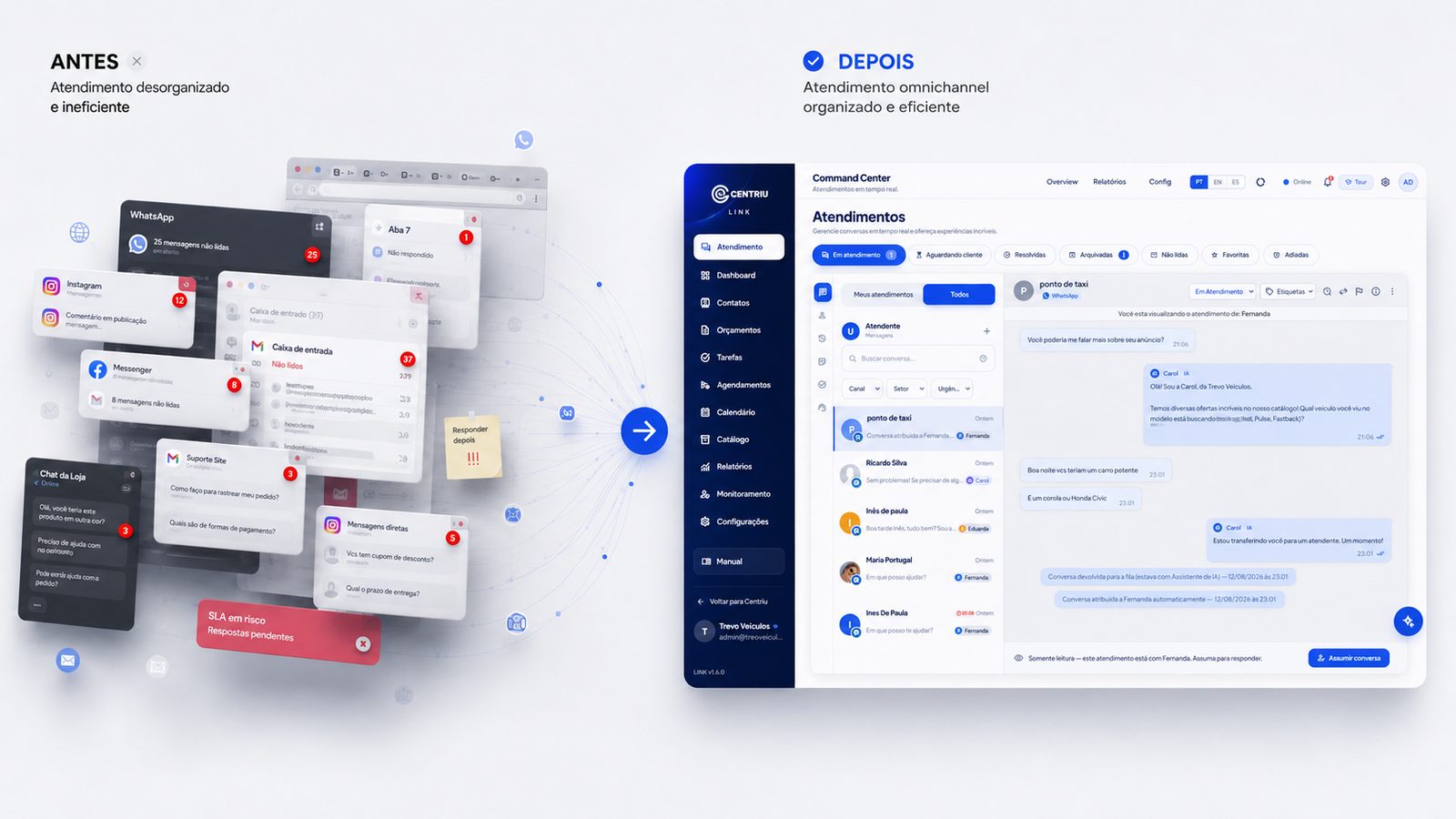
WhatsApp, Instagram, Messenger, chat do site e e-mail no mesmo contexto.
Tarefas, responsáveis, prazos, aprovações, agenda e capacidade.
Contas, cobranças, caixa, fiscal, margem, IR, orçamento e inteligência econômica.
Planejar, produzir, aprovar, publicar e medir conteúdo e campanhas.
Painéis, alertas, previsões, recomendações e leitura executiva.
Rotinas executadas continuamente pela IA com controle e aprovação.
Diagnóstico, estratégia, transformação, acompanhamento e especialistas.
A Centriu faz sentido quando o volume aumenta e a estrutura precisa acompanhar. Não é sobre setor nem tamanho: é sobre a operação conseguir sustentar o próximo estágio.
As vendas crescem, mas o processo não acompanha.
As áreas trabalham separadas e o cliente sente.
A operação depende de pessoas específicas.
O financeiro ficou complexo e o caixa perde visibilidade.
O atendimento cresce em volume e em canais.
A IA entra sem contexto, controle ou histórico.
Se a empresa ainda não começou a crescer, a Centriu também ajuda a preparar a estrutura para o primeiro salto.
Ver a Centriu funcionandoA Centriu combina tecnologia, inteligência, método e acompanhamento. A consultoria diagnostica, desenha, implanta e acompanha — com evidências, não com apresentação.
Diagnóstico e imersão na operação
Estratégia e prioridades
Roadmap de transformação
Desenho da arquitetura operacional
Implantação conduzida
Acompanhamento com evidências
Benchmarking e leitura de mercado
Especialistas, rede e inteligência coletiva
Uma conversa para entender onde a sua operação perde tempo, dinheiro ou capacidade — e o que a Centriu faria primeiro.
problema
When someone describes a goal to Centriu Axiom's AI, a short pipeline turns that goal into a recommendation and a set of suggested actions. An internal audit found two separate, compounding dead ends in that same short pipeline, each of which quietly manufactured a fake success instead of admitting failure. First: if the underlying AI proxy failed outright — a network error, an outage — the code silently returned a 209-line hardcoded Meta Ads campaign as if the AI had generated it, and the surrounding code PERSISTED that fabricated plan to the database and logged it to the audit trail as a genuine `recommendation_generated` event. Second, and separately: if the AI proxy responded but its answer couldn't be parsed as valid JSON, the code returned an empty recommendation carrying a manufactured `confidence: 30` — a specific, plausible-looking number attached to a response that never actually existed. Both paths now throw an explicit, honest error instead. Neither persists anything to the database or the audit trail when it fails, and the failure is deliberately caught one layer up, in the screen itself, specifically so it surfaces to the person as a visible message rather than disappearing as an unhandled error.

When a system genuinely fails — an error is thrown, a screen shows nothing, a spinner never stops — the failure is uncomfortable but at least visible: someone knows something went wrong and can retry, escalate, or wait. A failure path that instead returns something plausible-looking removes exactly that visibility. Nothing crashes, nothing looks broken, and the person on the other end has no reason to suspect that what they're looking at wasn't actually produced by the process they think produced it — the failure becomes invisible specifically because it was engineered, even unintentionally, to look like success.
When a system genuinely fails — an error is thrown, a screen shows nothing, a spinner never stops — the failure is uncomfortable but at least visible: someone knows something went wrong and can retry, escalate, or wait. A failure path that instead returns something plausible-looking removes exactly that visibility. Nothing crashes, nothing looks broken, and the person on the other end has no reason to suspect that what they're looking at wasn't actually produced by the process they think produced it — the failure becomes invisible specifically because it was engineered, even unintentionally, to look like success.
This gap surfaced from the same internal audit that rewrote Axiom's proof-of-action mechanism and closed several other gaps covered on this pillar's companion pages — the audit's own account of this specific defect states it plainly: "209 lines of pre-written Meta Ads campaign were returned whenever the proxy failed, and `useSession` PERSISTED it as a recommendation with `recommendation_generated` in the audit trail. Now it fails, and the failure appears." Reading the current source in full surfaced a second detail this pillar had not previously captured in full: the fix actually closes TWO separate, compounding dead ends in the same short pipeline, not one.
The first lived inside `callGeminiAPI`, the function that actually calls the AI proxy. If that call failed for any reason — a network error, the proxy being down, any outright failure — the code caught the error and returned the output of a separate function that fabricated a complete, plausible-looking Meta Ads campaign: a naming convention, target audiences, exclusion lists, creative suggestions with sample ad copy, a pre-publish and post-publish checklist, and a specific suggested daily budget — 209 lines of hardcoded content with zero relationship to the actual goal a person had typed in. Nothing about the returned value signaled it was a fallback; it was shaped exactly like a genuine AI response, and the calling code downstream had no way to tell the difference. That calling code, in `useSession.ts`, took whatever came back and created a real recommendation record from it, then logged a `recommendation_generated` event to the audit trail — meaning a complete AI outage could result in a durable database record and audit entry asserting that a real, goal-specific recommendation had been generated, when nothing had actually run.
The second dead end lived one step later and further downstream, inside `generateForSession`, the function that takes the AI proxy's raw text response and parses it as JSON. If that parsing failed — the AI responded, but its answer wasn't valid JSON, or didn't match the expected shape — the prior code caught that failure and returned a recommendation object with an empty summary and a manufactured `confidence: 30`. The current code's own comment on this exact fix asks precisely the right question about that number: "confidence 30% in what? There was no response to have confidence about." A specific, plausible-sounding percentage was invented and attached to a result that represented total failure to parse anything at all — and, exactly like the first dead end, that fabricated result was indistinguishable from a genuine low-confidence recommendation once it left the function, and was persisted the same way.
Both paths now throw an explicit error naming what actually happened, instead of returning anything. Neither has a fallback branch left in a catch block — deliberately, since a fallback there would simply recreate the same defect in a different form. Tracing the call chain forward into the current `useSession.ts` confirms both persistence points — creating the recommendation record and logging the `recommendation_generated` audit event — sit structurally AFTER the call to `generateForSession`, meaning neither is ever reached if either underlying function throws; a failure now genuinely prevents anything from being written, rather than writing a fabricated result instead. And because a function further up the chain (`generateRecommendations` in the hook) has no catch of its own around this call — deliberately, so the rejection propagates rather than being silently absorbed — the screen itself, `SessionView.tsx`, wraps the call in its own try/catch specifically to turn that rejection into a visible message. The current code's own comment at that exact call site states the reasoning directly: "the catch isn't caution for its own sake — without it, `generateRecommendations`' rejection becomes an unhandled promise rejection," which would have made the failure invisible in a different way, rather than surfacing it honestly to the person waiting for a response.
A genuine, explicit error thrown when the AI proxy fails to respond at all — replacing a 209-line hardcoded fake Meta Ads campaign returned silently in its place.
A genuine, explicit error thrown when the AI's response can't be parsed as valid JSON — replacing a fabricated empty recommendation carrying a manufactured, unearned confidence score.
Confirmed by tracing the current source: neither the recommendation record nor the `recommendation_generated` audit log entry is ever created when either failure occurs.
A dedicated try/catch in the screen itself, specifically added so a thrown failure surfaces as a visible message rather than an unhandled promise rejection.
No fallback value generated inside either failure path — both simply propagate an honest, specific error describing what actually happened.
Two independently fixed failure points in the same short pipeline, confirmed by reading the current source of both functions rather than assuming one fix covered the other.
A recommendation that appears in a session's history, or a `recommendation_generated` entry in the audit trail, now reliably means a real AI response was received and successfully parsed — not that one of two separate failure paths quietly manufactured something plausible instead. Someone whose request fails now sees an honest, actionable message immediately, rather than acting on a fabricated plan or a meaningless confidence number they had no reason to doubt.
A recommendation that appears in a session's history, or a `recommendation_generated` entry in the audit trail, now reliably means a real AI response was received and successfully parsed — not that one of two separate failure paths quietly manufactured something plausible instead. Someone whose request fails now sees an honest, actionable message immediately, rather than acting on a fabricated plan or a meaningless confidence number they had no reason to doubt.
The AI proxy goes down briefly while someone describes a campaign goal to Axiom. Before the fix, that person would have received a complete, confident-looking Meta Ads plan with real-sounding budgets and creative suggestions — entirely unrelated to what they actually asked for — and it would have been saved to their session's history as if genuinely generated. After the fix, they see a clear, honest message that the AI didn't respond and nothing was generated, with nothing saved to their history describing a plan that was never actually made.
The code silently returned a 209-line hardcoded fake Meta Ads campaign as if the AI had generated it, and that fabricated plan was persisted to the database and logged to the audit trail as a genuine recommendation.
If the AI responded but its answer couldn't be parsed as valid JSON, the code returned an empty recommendation with a manufactured `confidence: 30` — a number attached to a response that never actually existed.
Two genuinely separate failure points in the same short pipeline — one inside the AI call itself, one inside the response parsing that follows it — each independently identified and fixed.
The relevant function throws an explicit, honest error, nothing is persisted to the database or audit trail, and the screen catches the error to show a visible message.
Without it, the thrown error would become an unhandled promise rejection rather than a message the person waiting for a response can actually see — the code's own comment at that call site states this directly.
It is sold by subscription with a published starting price — exact current values are on the central pricing page.
When someone describes a goal to Centriu Axiom's AI, a short pipeline turns that goal into a recommendation and a set of suggested actions. An internal audit found two separate, compounding dead ends in that same short pipeline, each of which quietly manufactured a fake success instead of admitting failure. First: if the underlying AI proxy failed outright — a network error, an outage — the code silently returned a 209-line hardcoded Meta Ads campaign as if the AI had generated it, and the surrounding code PERSISTED that fabricated plan to the database and logged it to the audit trail as a genuine `recommendation_generated` event. Second, and separately: if the AI proxy responded but its answer couldn't be parsed as valid JSON, the code returned an empty recommendation carrying a manufactured `confidence: 30` — a specific, plausible-looking number attached to a response that never actually existed. Both paths now throw an explicit, honest error instead. Neither persists anything to the database or the audit trail when it fails, and the failure is deliberately caught one layer up, in the screen itself, specifically so it surfaces to the person as a visible message rather than disappearing as an unhandled error.