
Entende o contexto
Lê a operação, o cliente e o histórico antes de propor qualquer coisa.
Vendas, marketing, atendimento, operação, financeiro e inteligência trabalhando sobre o mesmo contexto — para sua empresa ganhar escala sem perder controle.
Sua empresa inteira. Uma operação. IA trabalhando.
Para empresas de qualquer setor que querem crescer com estrutura, controle e inteligência.
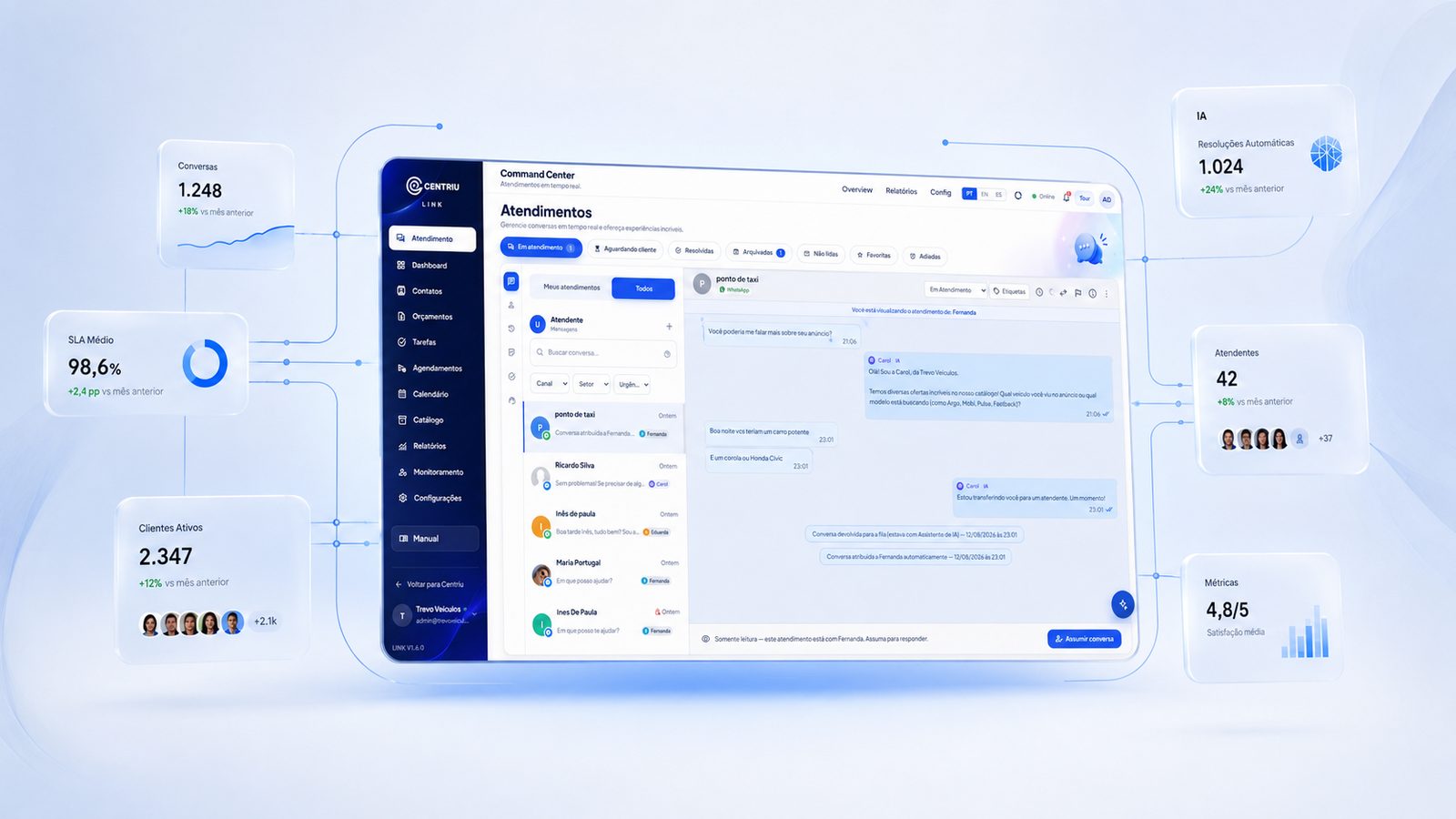
Painel ilustrativo do Sistema Centriu com sete frentes trabalhando: atendimento, comercial, operação, agentes, inteligência, conteúdo e marketing. Cada frente mostra o trabalho concluído ou o próximo passo.
Representação ilustrativa do trabalho em execução
Não é falta de ferramenta. É que cada ferramenta resolve um pedaço, e ninguém é dono do todo. O custo disso não aparece numa fatura — aparece no mês seguinte.
Sistemas que não se falam
O mesmo dado é digitado de novo — e cada cópia conta uma história diferente.
Dados duplicados
Ninguém sabe qual versão é a verdadeira na hora de decidir.
Conversas perdidas
O cliente repete o contexto a cada canal e a cada pessoa.
Tarefas espalhadas
O trabalho vive em planilhas, mensagens e na memória de alguém.
Decisões sem contexto
A escolha é feita com o recorte que estava à mão, não com o que importava.
Automações desconectadas
Cada ferramenta automatiza um pedaço e ninguém enxerga o todo.
Nenhum desses problemas se resolve comprando mais um software. Eles se resolvem quando a operação inteira passa a trabalhar sobre o mesmo contexto.
A Centriu não é uma coleção de produtos. É uma plataforma em que clientes, áreas e agentes leem e escrevem no mesmo lugar.
Cliente 360
Um contexto, não vários cadastros
Cada conversa, tarefa, campanha, cobrança e decisão fica ligada ao cliente e à operação — não a um sistema isolado.
As áreas abaixo são partes da mesma operação, não produtos separados. Elas compartilham conta, permissões e histórico.
A inteligência artificial da Centriu participa da operação: entende contexto, prepara trabalho, executa rotinas e pede aprovação quando importa.
Lê a operação, o cliente e o histórico antes de propor qualquer coisa.
Redige, organiza, calcula e deixa pronto para revisão humana.
Roda o que é repetitivo dentro dos limites definidos pela empresa.
Cruza áreas, identifica prioridade e mostra o motivo da recomendação.
O que é sensível passa por uma pessoa antes de valer. Sem exceção silenciosa.
Registra o que aconteceu e usa o resultado para melhorar a próxima decisão.
Uma plataforma, várias frentes de trabalho. Tudo no mesmo contexto, com a IA participando do que dá para acelerar.
CRM, pipeline, oportunidades, propostas, follow-up e automações.
WhatsApp, Instagram, Messenger, chat do site e e-mail no mesmo contexto.
Tarefas, responsáveis, prazos, aprovações, agenda e capacidade.
Contas, cobranças, caixa, fiscal, margem, IR, orçamento e inteligência econômica.
Planejar, produzir, aprovar, publicar e medir conteúdo e campanhas.
Painéis, alertas, previsões, recomendações e leitura executiva.
Rotinas executadas continuamente pela IA com controle e aprovação.
Diagnóstico, estratégia, transformação, acompanhamento e especialistas.
A Centriu faz sentido quando o volume aumenta e a estrutura precisa acompanhar. Não é sobre setor nem tamanho: é sobre a operação conseguir sustentar o próximo estágio.
As vendas crescem, mas o processo não acompanha.
As áreas trabalham separadas e o cliente sente.
A operação depende de pessoas específicas.
O financeiro ficou complexo e o caixa perde visibilidade.
O atendimento cresce em volume e em canais.
A IA entra sem contexto, controle ou histórico.
Se a empresa ainda não começou a crescer, a Centriu também ajuda a preparar a estrutura para o primeiro salto.
Ver a Centriu funcionandoA Centriu combina tecnologia, inteligência, método e acompanhamento. A consultoria diagnostica, desenha, implanta e acompanha — com evidências, não com apresentação.
Diagnóstico e imersão na operação
Estratégia e prioridades
Roadmap de transformação
Desenho da arquitetura operacional
Implantação conduzida
Acompanhamento com evidências
Benchmarking e leitura de mercado
Especialistas, rede e inteligência coletiva
Uma conversa para entender onde a sua operação perde tempo, dinheiro ou capacidade — e o que a Centriu faria primeiro.
problema
Centriu Maestro pulls live metrics for every active campaign. It works across all four connected platforms. It computes a 0-100 health score. It only files a specific, typed suggestion when something looks off. This suggestion can be a budget change, a targeting adjustment, a creative swap, a bid change, a pause, a resume, a keyword, or a schedule change. It comes with a stated reason and a severity level. A campaign performing fine gets zero suggestions. We need to be clear about what applying a suggestion does. The monitoring itself changes nothing. Every suggestion waits as pending. It waits until the campaign owner clicks to apply it. When that click is on a budget, bid, or pause suggestion, Maestro sends the change to the ad platform. It uses its own campaign update and control functions. For a targeting, creative, keyword, or schedule suggestion, the application is logged. No field actually changes. Making that change on the platform is still manual.
A monitoring feature watches campaign performance. It finds problems. This feature is useful even when it recommends instead of acts. A media buyer manages several accounts. They cannot re-read every metric on every platform every day. A health score with a stated reason saves time. The risk comes later, with the word "apply." Approving a suggestion inside a dashboard might look and feel like the change is happening on the ad platform. But if the ad platform never received it, a team might think a fix is live. This is worse than no suggestion at all. It replaces real uncertainty with false confidence.
A monitoring feature watches campaign performance. It finds problems. This feature is useful even when it recommends instead of acts. A media buyer manages several accounts. They cannot re-read every metric on every platform every day. A health score with a stated reason saves time. The risk comes later, with the word "apply." Approving a suggestion inside a dashboard might look and feel like the change is happening on the ad platform. But if the ad platform never received it, a team might think a fix is live. This is worse than no suggestion at all. It replaces real uncertainty with false confidence.
For every active campaign, Maestro fetches live metrics. It gets them from the platform the campaign runs on. These platforms are Google Ads, Meta, TikTok, or LinkedIn. Each is read through that platform's own reporting API, which is a way for programs to talk to each other. If a connection token is not available, it uses the campaign's last known cached data. It does this instead of skipping the analysis. An AI then reads the numbers. These numbers include spend, impressions, clicks, conversions, CTR, CPC, CPA, and ROAS. It checks them against the campaign's goal. It computes a health score from 0 to 100. If performance looks fine, it returns no suggestions. Nothing is made up to justify the monitoring run. When something looks off, one or more typed suggestions are filed. These can be for budget, targeting, creative, bid, pause, resume, keyword, or schedule. Each suggestion has the current value, the suggested value, a stated reason, and a severity. Severity goes from low to critical. This also decides how urgently a notification is sent.
Applying a suggestion calls a separate function. This function first confirms the person applying it owns the suggestion. It also confirms the suggestion is still open. What happens next depends on the type. A budget suggestion is sent to the ad platform as a new daily budget. A bid suggestion is sent as a new bid strategy or amount. A pause suggestion goes through the same campaign pause control Maestro uses elsewhere. Targeting, creative, keyword, and schedule suggestions are recorded. But they do not change any field today. This is because those changes are at the ad-set, ad-group, or creative level. This function does not call those levels. So, making these changes on the platform stays a manual step.
Live metric monitoring works across all four connected platforms. It uses cached data if a connection token is not available. This happens instead of skipping analysis.
A 0-100 health score is computed. It uses the campaign's actual metrics. It checks them against its stated goal.
Zero suggestions are made up for a campaign. This happens if the analysis shows it is performing fine. Silence is a valid and common result.
There are eight typed suggestion categories. These are budget, targeting, creative, bid, pause, resume, keyword, and schedule. Each has a stated reason. Each has a severity from low to critical.
Notification urgency is based on severity. A critical suggestion is different from a low-priority one. You can tell before you even open it.
Effects differ by suggestion type. Applying a budget, bid, or pause suggestion sends that change to the ad platform. This happens after the owner's click. Targeting, creative, keyword, and schedule suggestions are logged. They have no field effect.
A suggestion cannot be approved again if it has been applied, rejected, or expired. Its status is checked before any change is tried.
A team gets a truly filtered signal. Suggestions appear only when a specific metric pattern needs one. They are not constant background noise. Each suggestion has a stated reason. It is not just a vague "optimize" nudge. Only budget, bid, and pause suggestions go to the platform. This happens when their owner applies them. So, whether an applied suggestion changed the live campaign or needs a manual edit depends on its type.
A team gets a truly filtered signal. Suggestions appear only when a specific metric pattern needs one. They are not constant background noise. Each suggestion has a stated reason. It is not just a vague "optimize" nudge. Only budget, bid, and pause suggestions go to the platform. This happens when their owner applies them. So, whether an applied suggestion changed the live campaign or needs a manual edit depends on its type.
Overnight monitoring flags a campaign. It has a rapidly rising cost-per-acquisition. It files a "pause" suggestion. This suggestion is rated high severity. It has a stated reason. The reason cites the specific metric trend. Nothing has changed on the ad platform yet. The suggestion simply waits as pending.
In the morning, the media buyer owns the campaign. She reads the reason. She thinks about what she knows about the client this week. She applies it. That click sends the pause to the ad platform. It goes through Maestro's own campaign control. A second suggestion is for the same campaign. It is to narrow the targeting. This is applied too. But that one is only logged in Maestro. So she makes the targeting change herself. She does this inside the platform's own ad manager.

For budget, bid, and pause suggestions, yes. When the campaign owner applies one, Maestro sends that change to the ad platform. Targeting, creative, keyword, and schedule suggestions are recorded. They have no field effect. That change on the platform itself stays manual.
The monitoring pass can return zero suggestions. Nothing is made up just to justify the check having run.
There are eight typed categories. These are budget, targeting, creative, bid, pause, resume, keyword, and schedule. Each has a stated reason. Each has a severity from low to critical.
On a connected account, applying it sends the pause to the ad platform. It goes through Maestro's own campaign control. Until the campaign owner clicks, the suggestion is only pending. The campaign keeps running.
The analysis still runs. It uses the campaign's last known cached metrics. It does this instead of skipping the check entirely.
It is sold by subscription. It has a published starting price. Exact current values are on the central pricing page.
Centriu Maestro pulls live metrics for every active campaign. It works across all four connected platforms. It computes a 0-100 health score. It only files a specific, typed suggestion when something looks off. This suggestion can be a budget change, a targeting adjustment, a creative swap, a bid change, a pause, a resume, a keyword, or a schedule change. It comes with a stated reason and a severity level. A campaign performing fine gets zero suggestions. We need to be clear about what applying a suggestion does. The monitoring itself changes nothing. Every suggestion waits as pending. It waits until the campaign owner clicks to apply it. When that click is on a budget, bid, or pause suggestion, Maestro sends the change to the ad platform. It uses its own campaign update and control functions. For a targeting, creative, keyword, or schedule suggestion, the application is logged. No field actually changes. Making that change on the platform is still manual.