
Entende o contexto
Lê a operação, o cliente e o histórico antes de propor qualquer coisa.
Vendas, marketing, atendimento, operação, financeiro e inteligência trabalhando sobre o mesmo contexto — para sua empresa ganhar escala sem perder controle.
Sua empresa inteira. Uma operação. IA trabalhando.
Para empresas de qualquer setor que querem crescer com estrutura, controle e inteligência.
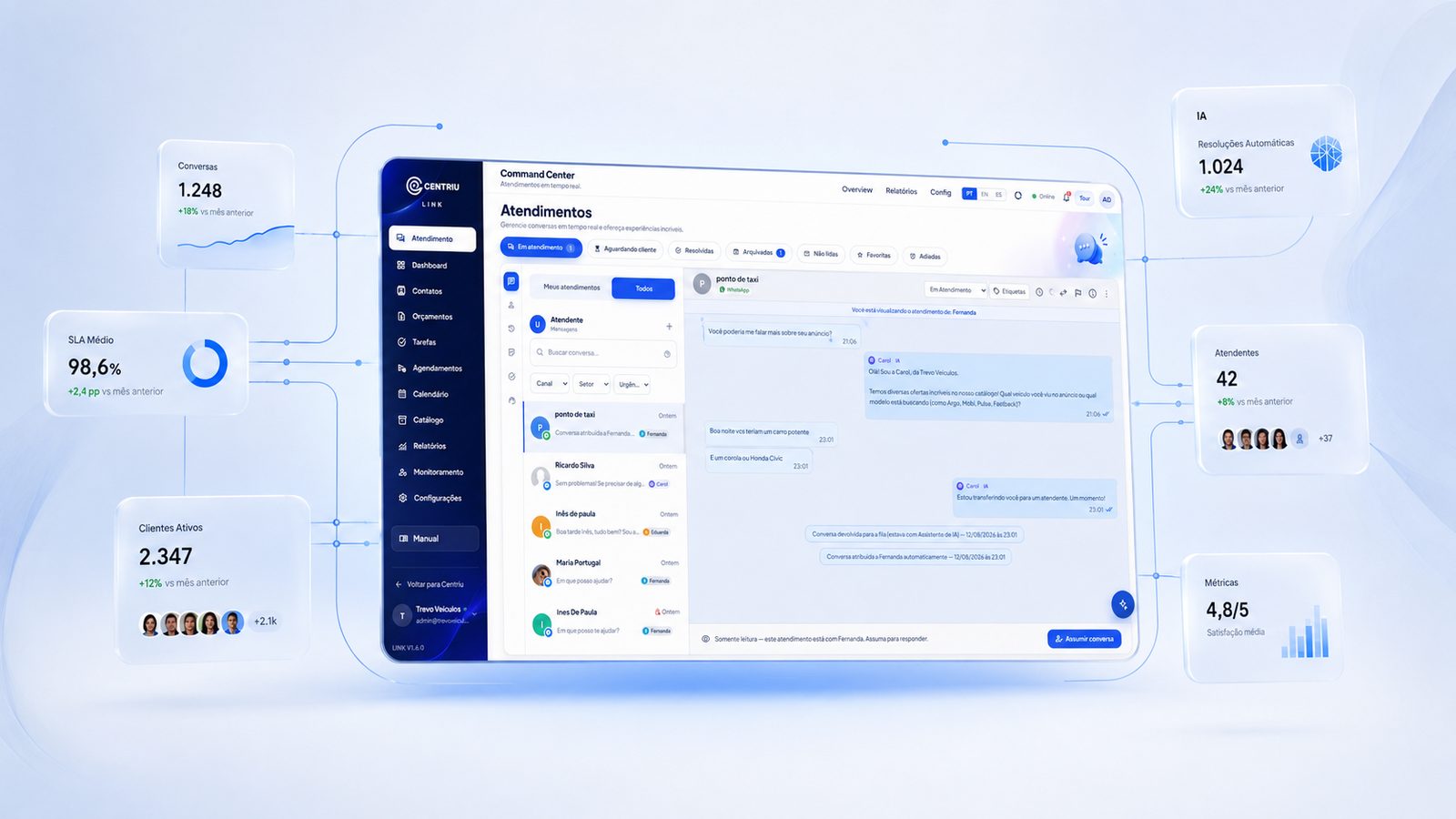
Painel ilustrativo do Sistema Centriu com sete frentes trabalhando: atendimento, comercial, operação, agentes, inteligência, conteúdo e marketing. Cada frente mostra o trabalho concluído ou o próximo passo.
Representação ilustrativa do trabalho em execução
Não é falta de ferramenta. É que cada ferramenta resolve um pedaço, e ninguém é dono do todo. O custo disso não aparece numa fatura — aparece no mês seguinte.
Sistemas que não se falam
O mesmo dado é digitado de novo — e cada cópia conta uma história diferente.
Dados duplicados
Ninguém sabe qual versão é a verdadeira na hora de decidir.
Conversas perdidas
O cliente repete o contexto a cada canal e a cada pessoa.
Tarefas espalhadas
O trabalho vive em planilhas, mensagens e na memória de alguém.
Decisões sem contexto
A escolha é feita com o recorte que estava à mão, não com o que importava.
Automações desconectadas
Cada ferramenta automatiza um pedaço e ninguém enxerga o todo.
Nenhum desses problemas se resolve comprando mais um software. Eles se resolvem quando a operação inteira passa a trabalhar sobre o mesmo contexto.
A Centriu não é uma coleção de produtos. É uma plataforma em que clientes, áreas e agentes leem e escrevem no mesmo lugar.
Cliente 360
Um contexto, não vários cadastros
Cada conversa, tarefa, campanha, cobrança e decisão fica ligada ao cliente e à operação — não a um sistema isolado.
As áreas abaixo são partes da mesma operação, não produtos separados. Elas compartilham conta, permissões e histórico.
A inteligência artificial da Centriu participa da operação: entende contexto, prepara trabalho, executa rotinas e pede aprovação quando importa.
Lê a operação, o cliente e o histórico antes de propor qualquer coisa.
Redige, organiza, calcula e deixa pronto para revisão humana.
Roda o que é repetitivo dentro dos limites definidos pela empresa.
Cruza áreas, identifica prioridade e mostra o motivo da recomendação.
O que é sensível passa por uma pessoa antes de valer. Sem exceção silenciosa.
Registra o que aconteceu e usa o resultado para melhorar a próxima decisão.
Uma plataforma, várias frentes de trabalho. Tudo no mesmo contexto, com a IA participando do que dá para acelerar.
CRM, pipeline, oportunidades, propostas, follow-up e automações.
WhatsApp, Instagram, Messenger, chat do site e e-mail no mesmo contexto.
Tarefas, responsáveis, prazos, aprovações, agenda e capacidade.
Contas, cobranças, caixa, fiscal, margem, IR, orçamento e inteligência econômica.
Planejar, produzir, aprovar, publicar e medir conteúdo e campanhas.
Painéis, alertas, previsões, recomendações e leitura executiva.
Rotinas executadas continuamente pela IA com controle e aprovação.
Diagnóstico, estratégia, transformação, acompanhamento e especialistas.
A Centriu faz sentido quando o volume aumenta e a estrutura precisa acompanhar. Não é sobre setor nem tamanho: é sobre a operação conseguir sustentar o próximo estágio.
As vendas crescem, mas o processo não acompanha.
As áreas trabalham separadas e o cliente sente.
A operação depende de pessoas específicas.
O financeiro ficou complexo e o caixa perde visibilidade.
O atendimento cresce em volume e em canais.
A IA entra sem contexto, controle ou histórico.
Se a empresa ainda não começou a crescer, a Centriu também ajuda a preparar a estrutura para o primeiro salto.
Ver a Centriu funcionandoA Centriu combina tecnologia, inteligência, método e acompanhamento. A consultoria diagnostica, desenha, implanta e acompanha — com evidências, não com apresentação.
Diagnóstico e imersão na operação
Estratégia e prioridades
Roadmap de transformação
Desenho da arquitetura operacional
Implantação conduzida
Acompanhamento com evidências
Benchmarking e leitura de mercado
Especialistas, rede e inteligência coletiva
Uma conversa para entender onde a sua operação perde tempo, dinheiro ou capacidade — e o que a Centriu faria primeiro.
problema
A real client asked a plain question on 2026-09-05. After reauthenticating, was their Instagram connection still working correctly? Two staff members tried to answer and couldn't. The honest answer lived in two separate places. One was a channel-connection record showing status, activity, and last-sync time. The other was a completely different table of the last 14 days of scheduled-post outcomes. Nothing joined them into one view. An AI agent or a person could not read it in a single call. The fix adds exactly that. One tool returns, per client and channel, the connection status. It shows whether it's active and when it last synced. It shows whether a token is on file (never the token itself). It also shows a 14-day publish scoreboard. This includes posts that went out, posts that failed, and the specific error text of the most recent failure. A connection showing active, recently synced, with real posts going out in the same window is the best test available. The tool's own words say this. It shows the integration is genuinely working.

A connection-status record and a publish-history table can each be entirely accurate on their own terms. Still, they fail to answer the one question a client actually asks. Is this working right now? The connection record knows whether a token exists and when it last synced. The publish history knows whether real posts actually went out or failed. Neither one, alone, tells the full story. Until something reads both together, answering "is my connection okay" requires someone to manually cross-reference two different screens. Or, they simply guess.
A connection-status record and a publish-history table can each be entirely accurate on their own terms. Still, they fail to answer the one question a client actually asks. Is this working right now? The connection record knows whether a token exists and when it last synced. The publish history knows whether real posts actually went out or failed. Neither one, alone, tells the full story. Until something reads both together, answering "is my connection okay" requires someone to manually cross-reference two different screens. Or, they simply guess.
The triggering incident was specific. A client asked whether their Instagram connection was still correctly configured after going through a reauthentication flow. The connection record itself showed a healthy status and a same-day sync. This was genuinely accurate information. But that record alone cannot confirm whether the connection actually WORKS. Syncing metadata and successfully publishing content are two distinct operations. The real proof that an integration works is that content scheduled through it actually goes out. This lived entirely in a separate scheduled-posts table. The connection-status view never touched it.
The first version of the new tool returned one structured record per client-channel pair. This included the connection's status and active flag. It showed when it last synced. It showed whether an access token or long-lived token is present. This is reported only as "present" or "absent." The actual token value is never read into the response. It also included two counts pulled from the last 14 days of that channel's scheduled posts. This showed how many published successfully and how many failed. Plus, when there was at least one failure, it showed the date and a truncated excerpt of the most recent error message.
A second pass shipped the same day. The tool was checked against real client volume. It rewrote the output from one JSON object per connection into a single compact text line per connection. This line included client name, channel, account, status, active/inactive, last-sync time, token presence, and the 14-day publish scoreboard. All this was on one line. The object-per-record version produced roughly 12,000 characters for just thirteen real clients. This was well past what the chat interface reliably displays in one response. The tool's own guidance is direct about what the result means. A connection that is active, recently synced, AND has real posts going out in the same window is a strong test. The tool's own stated words say this. It shows the integration is genuinely working. A recent failure surfaces its actual cause directly in the same line. It does not require a second lookup.
A single tool call returns every client-channel connection in the organization. It shows status, active/inactive, last-sync time, and whether a token is present. It never shows the token value itself.
The same call returns a 14-day publish scoreboard per connection. This includes posts that published successfully and posts that failed. It is computed from the actual scheduled-post outcomes. It is not from the connection record alone.
A recent failure surfaces its date and a truncated excerpt of the real error message. This is directly alongside the connection it belongs to.
Output is formatted as one compact line per connection. It is not a nested object per record. This change happened after the first version produced roughly 12,000 characters for just thirteen real clients.
The tool's own guidance states its read explicitly. Active, recently synced, and publishing successfully in the same window is treated as the strongest available evidence. This shows that a connection genuinely works.
No argument is required to call it. It returns every client the requesting organization has. These can be scanned by name rather than looked up one at a time.
Any team member or AI agent can now answer a client's channel-connection question from a single tool call. The actual publish outcomes, not just sync metadata, are the basis for the answer. This closes a gap where two separate staff members had no way to answer the identical real question.
Any team member or AI agent can now answer a client's channel-connection question from a single tool call. The actual publish outcomes, not just sync metadata, are the basis for the answer. This closes a gap where two separate staff members had no way to answer the identical real question.
A client reauthenticates their Instagram account. They ask whether everything still works. Before the fix, answering that honestly meant manually opening the connection record to check sync status. Then, it meant separately opening the post-scheduling history to check whether anything has actually gone out since. These were two screens, with no single answer. After the fix, one tool call returns both facts together for that exact client and channel. It shows the connection is active, synced this morning, six posts published, and zero failed in the last 14 days. This is a complete, one-line answer to the exact question that was asked.
The connection's sync status and its actual publish outcomes lived in two separate tables. Nothing joined them together. Each person could see one half of the picture, but not both at once.
No. It reports only whether a token is present or absent for a given connection. The actual token value is never read into the tool's output.
The tool's own guidance says what counts as proof. This is an active status, a recent sync, AND real posts publishing successfully in the same 14-day window. Sync health alone is not treated as sufficient proof.
The first version produced roughly 12,000 characters of output for just thirteen real clients. This was far more than a chat response can usefully display. The compact one-line format keeps the same information readable at real client volume.
No. It diagnoses and reports. Reconnecting or reauthenticating a broken channel remains a separate, deliberate action. A person takes this action.
It is sold by subscription with a published starting price. Exact current values are on the central pricing page.
A real client asked a plain question on 2026-09-05. After reauthenticating, was their Instagram connection still working correctly? Two staff members tried to answer and couldn't. The honest answer lived in two separate places. One was a channel-connection record showing status, activity, and last-sync time. The other was a completely different table of the last 14 days of scheduled-post outcomes. Nothing joined them into one view. An AI agent or a person could not read it in a single call. The fix adds exactly that. One tool returns, per client and channel, the connection status. It shows whether it's active and when it last synced. It shows whether a token is on file (never the token itself). It also shows a 14-day publish scoreboard. This includes posts that went out, posts that failed, and the specific error text of the most recent failure. A connection showing active, recently synced, with real posts going out in the same window is the best test available. The tool's own words say this. It shows the integration is genuinely working.