
Entende o contexto
Lê a operação, o cliente e o histórico antes de propor qualquer coisa.
Vendas, marketing, atendimento, operação, financeiro e inteligência trabalhando sobre o mesmo contexto — para sua empresa ganhar escala sem perder controle.
Sua empresa inteira. Uma operação. IA trabalhando.
Para empresas de qualquer setor que querem crescer com estrutura, controle e inteligência.
Painel ilustrativo do Sistema Centriu com sete frentes trabalhando: atendimento, comercial, operação, agentes, inteligência, conteúdo e marketing. Cada frente mostra o trabalho concluído ou o próximo passo.
Representação ilustrativa do trabalho em execução
Não é falta de ferramenta. É que cada ferramenta resolve um pedaço, e ninguém é dono do todo. O custo disso não aparece numa fatura — aparece no mês seguinte.
Sistemas que não se falam
O mesmo dado é digitado de novo — e cada cópia conta uma história diferente.
Dados duplicados
Ninguém sabe qual versão é a verdadeira na hora de decidir.
Conversas perdidas
O cliente repete o contexto a cada canal e a cada pessoa.
Tarefas espalhadas
O trabalho vive em planilhas, mensagens e na memória de alguém.
Decisões sem contexto
A escolha é feita com o recorte que estava à mão, não com o que importava.
Automações desconectadas
Cada ferramenta automatiza um pedaço e ninguém enxerga o todo.
Nenhum desses problemas se resolve comprando mais um software. Eles se resolvem quando a operação inteira passa a trabalhar sobre o mesmo contexto.
A Centriu não é uma coleção de produtos. É uma plataforma em que clientes, áreas e agentes leem e escrevem no mesmo lugar.
Cliente 360
Um contexto, não vários cadastros
Cada conversa, tarefa, campanha, cobrança e decisão fica ligada ao cliente e à operação — não a um sistema isolado.
As áreas abaixo são partes da mesma operação, não produtos separados. Elas compartilham conta, permissões e histórico.
A inteligência artificial da Centriu participa da operação: entende contexto, prepara trabalho, executa rotinas e pede aprovação quando importa.
Lê a operação, o cliente e o histórico antes de propor qualquer coisa.
Redige, organiza, calcula e deixa pronto para revisão humana.
Roda o que é repetitivo dentro dos limites definidos pela empresa.
Cruza áreas, identifica prioridade e mostra o motivo da recomendação.
O que é sensível passa por uma pessoa antes de valer. Sem exceção silenciosa.
Registra o que aconteceu e usa o resultado para melhorar a próxima decisão.
Uma plataforma, várias frentes de trabalho. Tudo no mesmo contexto, com a IA participando do que dá para acelerar.
CRM, pipeline, oportunidades, propostas, follow-up e automações.
WhatsApp, Instagram, Messenger, chat do site e e-mail no mesmo contexto.
Tarefas, responsáveis, prazos, aprovações, agenda e capacidade.
Contas, cobranças, caixa, fiscal, margem, IR, orçamento e inteligência econômica.
Planejar, produzir, aprovar, publicar e medir conteúdo e campanhas.
Painéis, alertas, previsões, recomendações e leitura executiva.
Rotinas executadas continuamente pela IA com controle e aprovação.
Diagnóstico, estratégia, transformação, acompanhamento e especialistas.
A Centriu faz sentido quando o volume aumenta e a estrutura precisa acompanhar. Não é sobre setor nem tamanho: é sobre a operação conseguir sustentar o próximo estágio.
As vendas crescem, mas o processo não acompanha.
As áreas trabalham separadas e o cliente sente.
A operação depende de pessoas específicas.
O financeiro ficou complexo e o caixa perde visibilidade.
O atendimento cresce em volume e em canais.
A IA entra sem contexto, controle ou histórico.
Se a empresa ainda não começou a crescer, a Centriu também ajuda a preparar a estrutura para o primeiro salto.
Ver a Centriu funcionandoA Centriu combina tecnologia, inteligência, método e acompanhamento. A consultoria diagnostica, desenha, implanta e acompanha — com evidências, não com apresentação.
Diagnóstico e imersão na operação
Estratégia e prioridades
Roadmap de transformação
Desenho da arquitetura operacional
Implantação conduzida
Acompanhamento com evidências
Benchmarking e leitura de mercado
Especialistas, rede e inteligência coletiva
Uma conversa para entender onde a sua operação perde tempo, dinheiro ou capacidade — e o que a Centriu faria primeiro.
problema
Client report generation, through Centriu Atlas, replaces a manual month-end ritual of pulling numbers from several screens and writing them up by hand. One command pulls together roughly ten real data domains for a client's month. This command can be from the report screen or asked directly of the AI assistant in chat. The data includes what was produced versus planned, reach, impressions, engagement, follower growth, top posts, a comparison against the prior period, competitor snapshots, campaign summaries, sentiment and ROI. All this data goes into a single report. The report has an optional AI-written narrative summarizing what happened. If the AI narrative is requested and fails, the report is not blocked. It is delivered with a deterministic, template-written narrative instead. The failure is reported back rather than hidden. The report is always labeled to show which kind of narrative it actually got.
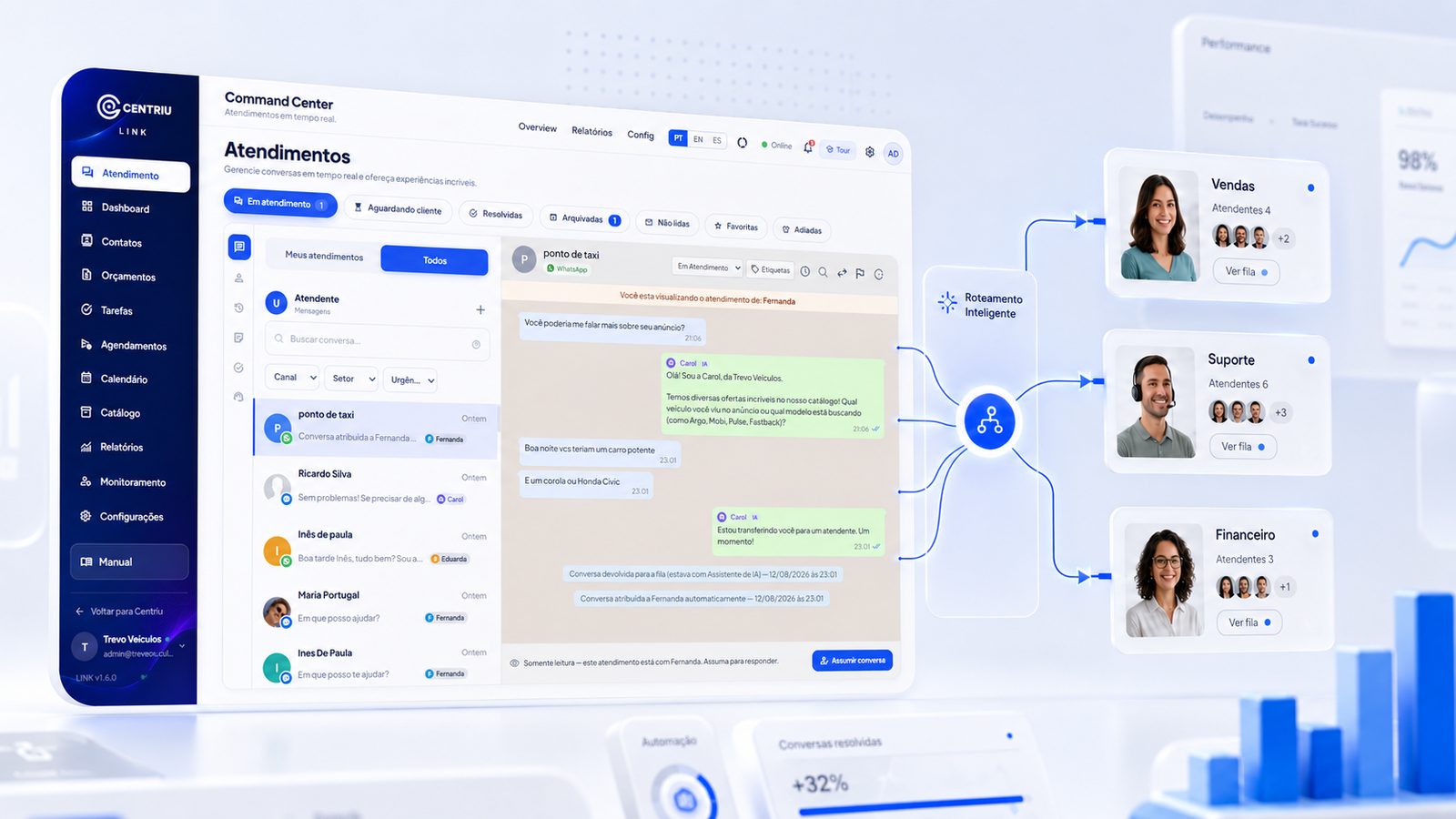
A monthly client report sounds like a five-minute task. But someone actually sits down to write one. Production numbers live in one screen. Engagement and reach are in another. Competitor notes are in a third. A written summary has to tie all of it into something a client will actually read. Multiply that by a real client roster. Then "just pull the numbers" quietly becomes the least strategic, most time-consuming afternoon of the month. This happens for every single client, every single month.
A monthly client report sounds like a five-minute task. But someone actually sits down to write one. Production numbers live in one screen. Engagement and reach are in another. Competitor notes are in a third. A written summary has to tie all of it into something a client will actually read. Multiply that by a real client roster. Then "just pull the numbers" quietly becomes the least strategic, most time-consuming afternoon of the month. This happens for every single client, every single month.
One entry point handles generation everywhere it can be triggered from. This includes the report screen, the "regenerate" action, and the AI assistant's own generate_report tool in chat. All these call the exact same underlying service. So a report generated by asking the assistant is identical to one generated by clicking a button. Generation gathers the month's real data across roughly ten domains. These include production against plan, reach, impressions, engagement rate, follower growth, the top-performing posts, a computed comparison against the previous period, competitor snapshots, campaign summaries, sentiment and ROI. All this goes into one report record.
When an AI-written narrative is requested, the gathered numbers are sent. The client's tone-of-voice profile and any notes on file are also sent. This is to generate a summary, recommendations and a preview of next month's plan. If that call fails for any reason, the report is still generated and delivered. It will have the deterministic, template-written narrative in its place. The failure reason is returned to whoever asked, not hidden. Every report permanently records which kind of narrative it actually received. That label is what a report list shows, not an assumption.
A single generation service is called in the same way by the UI, the regenerate action, and the AI assistant's chat tool. There is no separate new version to get out of sync.
It gathers data across roughly ten real data domains per report. These include production vs. plan, reach/impressions/engagement/follower growth, top posts, a period-over-period comparison, competitor snapshots, campaign summaries, sentiment and ROI.
An optional AI-written narrative (summary, recommendations, next-month preview) is generated. It uses the real gathered numbers plus the client's tone-of-voice and notes.
A non-silent fallback means an AI narrative request that fails still produces a delivered report. This report has the deterministic narrative. The specific failure reason is returned to the person who asked.
Every report has a permanent, always-shown label. This label records if its narrative came from the AI or the standard template.
Version snapshotting happens before any regeneration overwrites a report. Also, a required "force" flag means a second generation attempt for the same period cannot happen by accident.
Generating a client report stops being a repeated manual check across several screens. It becomes a single action. Anyone on the team, or the AI assistant for them, can start it. The numbers are guaranteed to be consistent. This is because they were pulled once, all together. Adding an AI-written narrative on top is optional. It is never a silent risk. The report always says which kind of narrative it actually contains. A failed AI call never turns into a missing or made-up report.
Generating a client report stops being a repeated manual check across several screens. It becomes a single action. Anyone on the team, or the AI assistant for them, can start it. The numbers are guaranteed to be consistent. This is because they were pulled once, all together. Adding an AI-written narrative on top is optional. It is never a silent risk. The report always says which kind of narrative it actually contains. A failed AI call never turns into a missing or made-up report.
An account manager types into the AI assistant: "generate last month's report for this client, with an AI summary." The assistant calls the same generation service the report screen itself uses. It gathers production, reach, engagement, the month-over-month comparison and the rest. Then it asks for an AI-written narrative. This narrative is built from those real numbers and the client's tone-of-voice profile. The narrative comes back successfully this time. The assistant confirms the report was generated with an AI-written summary. If the AI call had instead failed — a timeout, a provider error — the same command would still have produced a complete, deliverable report. This report would have the standard template narrative. The assistant would have said plainly that the AI text did not come through this time.
No — generation is started by a person in the report screen or by a command to the AI assistant. A separate, internal-only weekly cron exists for the agency's own portfolio dashboard. It is never sent to a client.
The report is still generated and delivered. It has the deterministic template narrative in its place. The specific failure reason is returned rather than hidden.
Every report permanently records and displays which kind of narrative it actually received. There is no need to guess.
Yes, with a required "force" flag. The previous version is saved first. So what the client already received remains on record.
Roughly ten real domains for the period go into the report. These include production against plan, reach, impressions, engagement, follower growth, top posts, a comparison to the prior period, competitor snapshots, campaign summaries, sentiment and ROI.
It is sold with tiered plans. These start at a published entry price. Each plan has an AI usage limit (a 'franquia') that stops use if exceeded. This limit applies across a 5-hour session window and a 7-day weekly window. Current prices are on the central pricing page.
Client report generation, through Centriu Atlas, replaces a manual month-end ritual of pulling numbers from several screens and writing them up by hand. One command pulls together roughly ten real data domains for a client's month. This command can be from the report screen or asked directly of the AI assistant in chat. The data includes what was produced versus planned, reach, impressions, engagement, follower growth, top posts, a comparison against the prior period, competitor snapshots, campaign summaries, sentiment and ROI. All this data goes into a single report. The report has an optional AI-written narrative summarizing what happened. If the AI narrative is requested and fails, the report is not blocked. It is delivered with a deterministic, template-written narrative instead. The failure is reported back rather than hidden. The report is always labeled to show which kind of narrative it actually got.