
Entende o contexto
Lê a operação, o cliente e o histórico antes de propor qualquer coisa.
Vendas, marketing, atendimento, operação, financeiro e inteligência trabalhando sobre o mesmo contexto — para sua empresa ganhar escala sem perder controle.
Sua empresa inteira. Uma operação. IA trabalhando.
Para empresas de qualquer setor que querem crescer com estrutura, controle e inteligência.
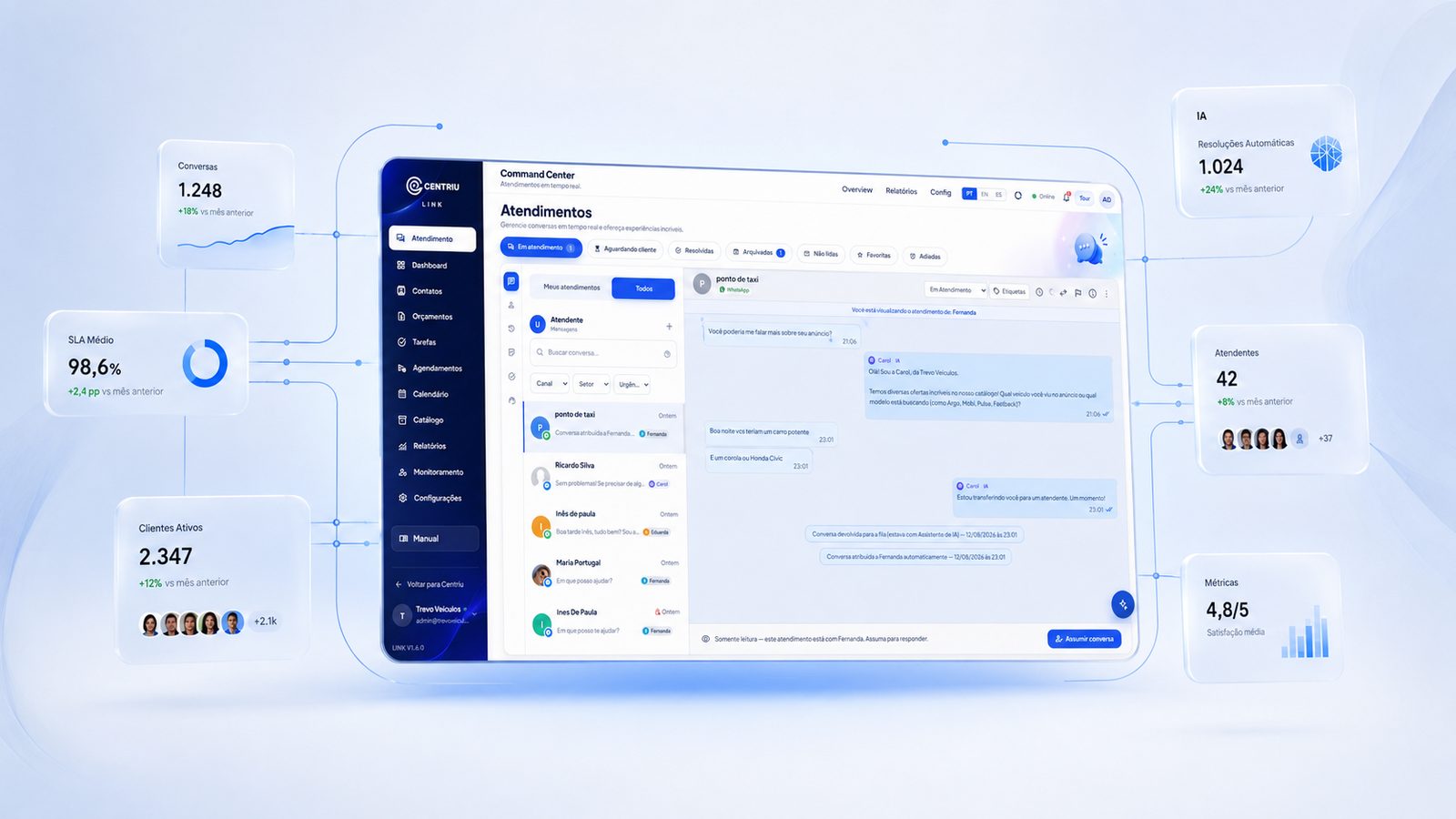
Painel ilustrativo do Sistema Centriu com sete frentes trabalhando: atendimento, comercial, operação, agentes, inteligência, conteúdo e marketing. Cada frente mostra o trabalho concluído ou o próximo passo.
Representação ilustrativa do trabalho em execução
Não é falta de ferramenta. É que cada ferramenta resolve um pedaço, e ninguém é dono do todo. O custo disso não aparece numa fatura — aparece no mês seguinte.
Sistemas que não se falam
O mesmo dado é digitado de novo — e cada cópia conta uma história diferente.
Dados duplicados
Ninguém sabe qual versão é a verdadeira na hora de decidir.
Conversas perdidas
O cliente repete o contexto a cada canal e a cada pessoa.
Tarefas espalhadas
O trabalho vive em planilhas, mensagens e na memória de alguém.
Decisões sem contexto
A escolha é feita com o recorte que estava à mão, não com o que importava.
Automações desconectadas
Cada ferramenta automatiza um pedaço e ninguém enxerga o todo.
Nenhum desses problemas se resolve comprando mais um software. Eles se resolvem quando a operação inteira passa a trabalhar sobre o mesmo contexto.
A Centriu não é uma coleção de produtos. É uma plataforma em que clientes, áreas e agentes leem e escrevem no mesmo lugar.
Cliente 360
Um contexto, não vários cadastros
Cada conversa, tarefa, campanha, cobrança e decisão fica ligada ao cliente e à operação — não a um sistema isolado.
As áreas abaixo são partes da mesma operação, não produtos separados. Elas compartilham conta, permissões e histórico.
A inteligência artificial da Centriu participa da operação: entende contexto, prepara trabalho, executa rotinas e pede aprovação quando importa.
Lê a operação, o cliente e o histórico antes de propor qualquer coisa.
Redige, organiza, calcula e deixa pronto para revisão humana.
Roda o que é repetitivo dentro dos limites definidos pela empresa.
Cruza áreas, identifica prioridade e mostra o motivo da recomendação.
O que é sensível passa por uma pessoa antes de valer. Sem exceção silenciosa.
Registra o que aconteceu e usa o resultado para melhorar a próxima decisão.
Uma plataforma, várias frentes de trabalho. Tudo no mesmo contexto, com a IA participando do que dá para acelerar.
CRM, pipeline, oportunidades, propostas, follow-up e automações.
WhatsApp, Instagram, Messenger, chat do site e e-mail no mesmo contexto.
Tarefas, responsáveis, prazos, aprovações, agenda e capacidade.
Contas, cobranças, caixa, fiscal, margem, IR, orçamento e inteligência econômica.
Planejar, produzir, aprovar, publicar e medir conteúdo e campanhas.
Painéis, alertas, previsões, recomendações e leitura executiva.
Rotinas executadas continuamente pela IA com controle e aprovação.
Diagnóstico, estratégia, transformação, acompanhamento e especialistas.
A Centriu faz sentido quando o volume aumenta e a estrutura precisa acompanhar. Não é sobre setor nem tamanho: é sobre a operação conseguir sustentar o próximo estágio.
As vendas crescem, mas o processo não acompanha.
As áreas trabalham separadas e o cliente sente.
A operação depende de pessoas específicas.
O financeiro ficou complexo e o caixa perde visibilidade.
O atendimento cresce em volume e em canais.
A IA entra sem contexto, controle ou histórico.
Se a empresa ainda não começou a crescer, a Centriu também ajuda a preparar a estrutura para o primeiro salto.
Ver a Centriu funcionandoA Centriu combina tecnologia, inteligência, método e acompanhamento. A consultoria diagnostica, desenha, implanta e acompanha — com evidências, não com apresentação.
Diagnóstico e imersão na operação
Estratégia e prioridades
Roadmap de transformação
Desenho da arquitetura operacional
Implantação conduzida
Acompanhamento com evidências
Benchmarking e leitura de mercado
Especialistas, rede e inteligência coletiva
Uma conversa para entender onde a sua operação perde tempo, dinheiro ou capacidade — e o que a Centriu faria primeiro.
problema
A decision, a risk, or an opportunity from a consulting job is useful. It must turn into tracked work. Re-typing it by hand into a separate CRM or task tool is often skipped. This happens under real workload. Centriu Oracle’s Continuity Hub lets a reviewed engagement item be forwarded. This happens after a person approves it. It goes directly into Orbit as a sales activity or a deal. Or it goes into Run as a backlog demand or an internal assignment. This is through an idempotent handoff. It refuses to create the same record twice. This happens even if the same forward is triggered more than once.

A consulting job finds real, specific things to act on. This could be a client risk that needs tracking. It could be a chance to grow that is worth pursuing. It could be a decision that means a follow-up task. The problem is not seeing these items. It is what happens next. There is no direct path from "we found this in the job" to "this is now a tracked record in the system." This is where the follow-up work actually happens. The item then lives only in a meeting note or a consultant’s memory. Most of the time it simply does not make the jump. Centriu Oracle’s Continuity Hub is built to close that gap.
A consulting engagement surfaces real, specific items worth acting on — a client risk that needs tracking, an expansion opportunity worth pursuing, a decision that implies a follow-up task. The gap is not noticing these items; it is what happens next. Without a direct path from "we identified this in the engagement" to "this is now a tracked record in the system where the follow-up work actually happens," the item lives only in a meeting note or a consultant’s memory, and most of the time it simply does not make the jump. Centriu Oracle’s Continuity Hub is built specifically to close that gap.
An engagement item can be forwarded. This includes a decision, a risk, an opportunity, an action item, or a plan task. It goes through human review first. Nothing forwards automatically without that clear approval step. Once approved, the consultant chooses where it goes. It can be an activity/follow-up or a deal/opportunity in Orbit. Or it can be a backlog demand or an internal assignment in Run. The forward itself runs through a database function. This function carries an idempotency key. So, triggering the same forward twice returns the existing record. It does not create a second one. The system reports that it was a duplicate. It does not silently make a copy. A successful forward gives a direct link to the new record in Orbit or Run. So, the handoff, or transfer, is traceable from start to finish.
A human review and approval step before any item can be forwarded — nothing crosses systems automatically.
Forwarding into Orbit as either an activity/follow-up or a deal/opportunity.
Forwarding into Run as either a backlog demand or an internal assignment.
An idempotency key on every forward. This means a repeated attempt returns the existing record. It does not make a copy.
A direct link back to the created record in Orbit or Run once the handoff, or transfer, succeeds.
The main change is a clear, traceable path. It goes from a reviewed engagement item to a real record. This record is in the system where the follow-up work actually happens. It has a built-in safeguard against accidental copies. How much this helps depends on a consultancy’s job volume. It also depends on their past process. Centriu does not give a specific number for this. This number would not work for everyone.
The structural change is a governed, traceable path from a reviewed engagement item to a real record in the system where the follow-up work actually happens, with a built-in safeguard against accidental duplicates. What that is worth in fewer dropped opportunities or untracked risks depends heavily on a consultancy’s own engagement volume and prior process — Centriu does not attach a specific figure that would generalize.
During a project review, the consultant flags a specific chance to grow. A client mentioned it briefly. This was extra work the client hinted at wanting next quarter. It sits as a reviewed item in the engagement’s continuity list. It is not yet forwarded anywhere.
The consultant approves forwarding it as a deal in Orbit. The Continuity Hub creates the opportunity. It returns a direct link to it. The sales team now has a real, trackable deal. It is not just a line in a meeting note.
A week later, someone on the team tries again. They are not sure if that item was already forwarded. The original forward had an idempotency key. So, the system sees the duplicate attempt. It returns the same existing deal. It does not create a second one. The sales pipeline stays clean.
No — human review and approval always come before a forward; nothing crosses systems automatically.
Either an activity/follow-up or a deal/opportunity — the consultant chooses which on each forward.
Either a backlog demand or an internal assignment.
The idempotency key on the forward means the second attempt returns the existing record instead of creating a duplicate.
Yes — a successful forward returns a direct link to the created record in Orbit or Run.
It is sold by subscription with a published starting price — exact current values are on the central pricing page.
A decision, a risk, or an opportunity from a consulting job is useful. It must turn into tracked work. Re-typing it by hand into a separate CRM or task tool is often skipped. This happens under real workload. Centriu Oracle’s Continuity Hub lets a reviewed engagement item be forwarded. This happens after a person approves it. It goes directly into Orbit as a sales activity or a deal. Or it goes into Run as a backlog demand or an internal assignment. This is through an idempotent handoff. It refuses to create the same record twice. This happens even if the same forward is triggered more than once.