
Entende o contexto
Lê a operação, o cliente e o histórico antes de propor qualquer coisa.
Vendas, marketing, atendimento, operação, financeiro e inteligência trabalhando sobre o mesmo contexto — para sua empresa ganhar escala sem perder controle.
Sua empresa inteira. Uma operação. IA trabalhando.
Para empresas de qualquer setor que querem crescer com estrutura, controle e inteligência.
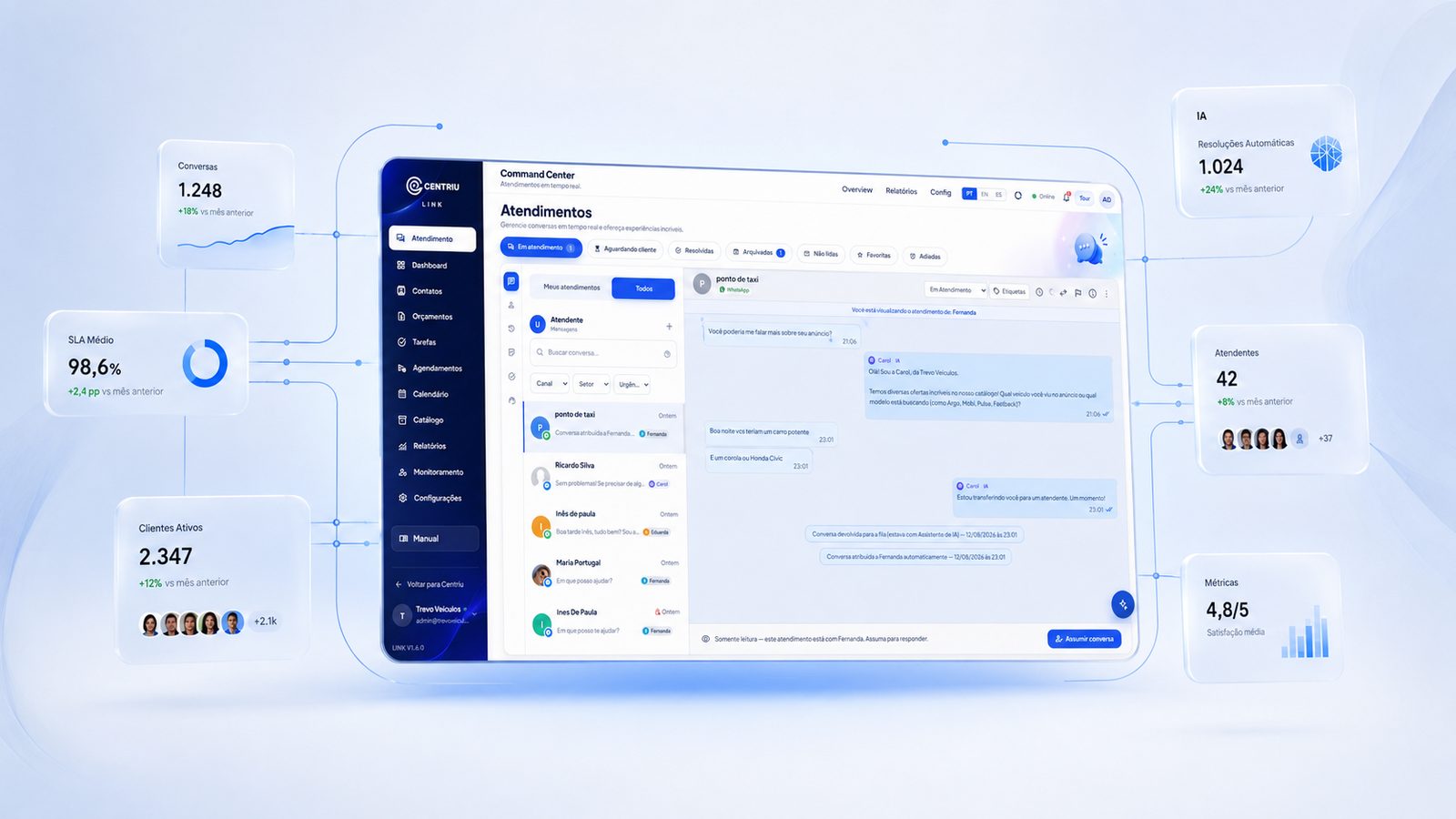
Painel ilustrativo do Sistema Centriu com sete frentes trabalhando: atendimento, comercial, operação, agentes, inteligência, conteúdo e marketing. Cada frente mostra o trabalho concluído ou o próximo passo.
Representação ilustrativa do trabalho em execução
Não é falta de ferramenta. É que cada ferramenta resolve um pedaço, e ninguém é dono do todo. O custo disso não aparece numa fatura — aparece no mês seguinte.
Sistemas que não se falam
O mesmo dado é digitado de novo — e cada cópia conta uma história diferente.
Dados duplicados
Ninguém sabe qual versão é a verdadeira na hora de decidir.
Conversas perdidas
O cliente repete o contexto a cada canal e a cada pessoa.
Tarefas espalhadas
O trabalho vive em planilhas, mensagens e na memória de alguém.
Decisões sem contexto
A escolha é feita com o recorte que estava à mão, não com o que importava.
Automações desconectadas
Cada ferramenta automatiza um pedaço e ninguém enxerga o todo.
Nenhum desses problemas se resolve comprando mais um software. Eles se resolvem quando a operação inteira passa a trabalhar sobre o mesmo contexto.
A Centriu não é uma coleção de produtos. É uma plataforma em que clientes, áreas e agentes leem e escrevem no mesmo lugar.
Cliente 360
Um contexto, não vários cadastros
Cada conversa, tarefa, campanha, cobrança e decisão fica ligada ao cliente e à operação — não a um sistema isolado.
As áreas abaixo são partes da mesma operação, não produtos separados. Elas compartilham conta, permissões e histórico.
A inteligência artificial da Centriu participa da operação: entende contexto, prepara trabalho, executa rotinas e pede aprovação quando importa.
Lê a operação, o cliente e o histórico antes de propor qualquer coisa.
Redige, organiza, calcula e deixa pronto para revisão humana.
Roda o que é repetitivo dentro dos limites definidos pela empresa.
Cruza áreas, identifica prioridade e mostra o motivo da recomendação.
O que é sensível passa por uma pessoa antes de valer. Sem exceção silenciosa.
Registra o que aconteceu e usa o resultado para melhorar a próxima decisão.
Uma plataforma, várias frentes de trabalho. Tudo no mesmo contexto, com a IA participando do que dá para acelerar.
CRM, pipeline, oportunidades, propostas, follow-up e automações.
WhatsApp, Instagram, Messenger, chat do site e e-mail no mesmo contexto.
Tarefas, responsáveis, prazos, aprovações, agenda e capacidade.
Contas, cobranças, caixa, fiscal, margem, IR, orçamento e inteligência econômica.
Planejar, produzir, aprovar, publicar e medir conteúdo e campanhas.
Painéis, alertas, previsões, recomendações e leitura executiva.
Rotinas executadas continuamente pela IA com controle e aprovação.
Diagnóstico, estratégia, transformação, acompanhamento e especialistas.
A Centriu faz sentido quando o volume aumenta e a estrutura precisa acompanhar. Não é sobre setor nem tamanho: é sobre a operação conseguir sustentar o próximo estágio.
As vendas crescem, mas o processo não acompanha.
As áreas trabalham separadas e o cliente sente.
A operação depende de pessoas específicas.
O financeiro ficou complexo e o caixa perde visibilidade.
O atendimento cresce em volume e em canais.
A IA entra sem contexto, controle ou histórico.
Se a empresa ainda não começou a crescer, a Centriu também ajuda a preparar a estrutura para o primeiro salto.
Ver a Centriu funcionandoA Centriu combina tecnologia, inteligência, método e acompanhamento. A consultoria diagnostica, desenha, implanta e acompanha — com evidências, não com apresentação.
Diagnóstico e imersão na operação
Estratégia e prioridades
Roadmap de transformação
Desenho da arquitetura operacional
Implantação conduzida
Acompanhamento com evidências
Benchmarking e leitura de mercado
Especialistas, rede e inteligência coletiva
Uma conversa para entender onde a sua operação perde tempo, dinheiro ou capacidade — e o que a Centriu faria primeiro.
problema
The worst failure a media-management dashboard can have is showing "paused" for a campaign that is still spending. Centriu Maestro is built so that cannot happen. When someone pauses, resumes or deletes a campaign — or archives it on Meta or LinkedIn — Maestro calls the ad platform's own API first. It only writes the new status to its own records after the platform confirms. If the platform call fails, nothing is written locally. The screen keeps telling the truth. If the platform reports the campaign no longer exists — because someone deleted it directly in the native ad manager — Maestro mirrors that deletion instead of pretending the requested action worked.
Anyone managing paid media across more than one platform ends up in front of a consolidated screen. Logging into four ad managers to pause four campaigns is not a workable way to work. That consolidation is genuinely useful. It introduces a specific, expensive risk. The moment a control panel keeps its own copy of a campaign's status, that copy can drift from what the platform actually believes. The direction the drift takes matters enormously. A dashboard that says "active" for something already paused causes confusion. A dashboard that says "paused" for something still running causes spend — quietly, continuously, and usually discovered at the end of the month.
Anyone managing paid media across more than one platform ends up in front of a consolidated screen. Logging into four ad managers to pause four campaigns is not a workable way to work. That consolidation is genuinely useful. It introduces a specific, expensive risk. The moment a control panel keeps its own copy of a campaign's status, that copy can drift from what the platform actually believes. The direction the drift takes matters enormously. A dashboard that says "active" for something already paused causes confusion. A dashboard that says "paused" for something still running causes spend — quietly, continuously, and usually discovered at the end of the month.
Four actions are wired — pause, resume, archive and delete. Each one runs the same sequence. Archive is not the same action everywhere. On Google Ads, it maps to the terminal REMOVED state. TikTok refuses it. The request is authenticated and checked against ownership of the campaign. The platform access token is fetched. It is refreshed automatically if it is within five minutes of expiring. The real API call is made against the platform in question: Google Ads, Meta, TikTok or LinkedIn. Each has its own status vocabulary mapped in code. Production use has been documented on Meta accounts alone. Only after the platform responds successfully does Maestro update the campaign row in its own records. It writes an audit entry recording who acted, the previous status, the new status, the platform, and the platform's own campaign identifier. Three real-world cases are handled explicitly rather than glossed over. A Google campaign inside a client's own ad account is operated in that account. It uses the connected account as the manager. Without that context, the platform rejects operations on sub-accounts. Deleting a campaign that was never published skips the platform call entirely. There is nothing on the platform to delete. If the platform reports the campaign is gone, Maestro removes its local copy rather than reporting a phantom success. Even the awkward failure mode is honest. If the platform accepted the change but Maestro's own write then failed, the response says precisely that. It does not return a generic error that would leave you guessing which of the two systems moved.
Four campaign actions — pause, resume, archive, delete — executed against the real ad platform API. Archive becomes a permanent removal on Google Ads and is unavailable on TikTok.
Status vocabularies implemented for four platforms — Google Ads, Meta, TikTok and LinkedIn. Documented production use covers Meta only.
Own records updated only after the platform confirms. A failed platform call writes nothing locally.
An audit entry per action records the actor, the previous status, the new status, the platform and the platform campaign identifier.
Automatic access-token refresh when the token is within five minutes of expiring.
Correct account context for Google campaigns inside a client's own ad account. Operations on sub-accounts are not rejected.
Explicit handling of a campaign deleted directly in the native ad manager. The local copy is removed rather than left as a phantom.
Deleting a never-published campaign skips the platform call entirely. A draft on a disconnected platform can still be removed.
Ownership and authentication checks before any action reaches a platform.
An explicit, distinguishable response when the platform accepted the change but the local write failed.
The structural change is that the consolidated screen and the ad platforms cannot silently disagree about whether money is being spent. An action either happened on the platform and is reflected locally, or it did not happen and nothing was written. There is no third state where the dashboard is confidently wrong. The audit entry means a pause on a live campaign is attributable afterwards. Centriu attaches no figure to what that prevents. It depends entirely on budget size and how many campaigns and platforms an operation runs.
The structural change is that the consolidated screen and the ad platforms cannot silently disagree about whether money is being spent. An action either happened on the platform and is reflected locally, or it did not happen and nothing was written. There is no third state where the dashboard is confidently wrong. The audit entry means a pause on a live campaign is attributable afterwards. Centriu attaches no figure to what that prevents. It depends entirely on budget size and how many campaigns and platforms an operation runs.
A media buyer needs three campaigns paused across two platforms before a public holiday. From one screen, she pauses each one. Behind each click, Maestro fetches the account token. It calls the platform, waits for the confirmation, and only then flips its own record to paused and writes the audit entry.
The third one fails. The campaign was deleted directly in the native ad manager two weeks earlier by someone else on the team. Rather than reporting a successful pause on something that no longer exists, Maestro recognizes the platform's answer. It removes the stale local row, and the screen now agrees with reality.
A fourth campaign lives inside the client's own ad account rather than the agency's. The pause is built for that case too. The call is made in the client's account using the connected account as the manager. This is the case that silently fails when a tool assumes every campaign belongs to the account that connected. After the holiday, resuming the three campaigns follows the same path in reverse. The audit trail holds who paused what, when, and what the status had been before.
Nothing is written locally. The action fails. The screen keeps showing the campaign's real status rather than a status Maestro wished for.
Pause, resume and delete are implemented against Google Ads, Meta, TikTok and LinkedIn. So far, only Meta accounts have documented production use. Archive differs. It works on Meta and LinkedIn. It turns into a permanent removal on Google Ads. TikTok has no archive endpoint. LinkedIn also only deletes drafts.
The platform reports it no longer exists. Maestro removes its local copy instead of reporting a successful action on something that is gone.
It is implemented. The operation is made in the client's account using the connected account as the manager. This is the account context those platforms require for sub-accounts. Production use of this path on Google Ads is not documented yet.
Yes. Each action writes an audit entry with the actor, the previous status, the new status, the platform and the platform campaign identifier.
No. Every change is a human decision. Monitoring produces recommendations. It does not push changes to the platform on its own.
It is sold by subscription with a published starting price. Exact current values are on the central pricing page.
The worst failure a media-management dashboard can have is showing "paused" for a campaign that is still spending. Centriu Maestro is built so that cannot happen. When someone pauses, resumes or deletes a campaign — or archives it on Meta or LinkedIn — Maestro calls the ad platform's own API first. It only writes the new status to its own records after the platform confirms. If the platform call fails, nothing is written locally. The screen keeps telling the truth. If the platform reports the campaign no longer exists — because someone deleted it directly in the native ad manager — Maestro mirrors that deletion instead of pretending the requested action worked.