
Entende o contexto
Lê a operação, o cliente e o histórico antes de propor qualquer coisa.
Vendas, marketing, atendimento, operação, financeiro e inteligência trabalhando sobre o mesmo contexto — para sua empresa ganhar escala sem perder controle.
Sua empresa inteira. Uma operação. IA trabalhando.
Para empresas de qualquer setor que querem crescer com estrutura, controle e inteligência.
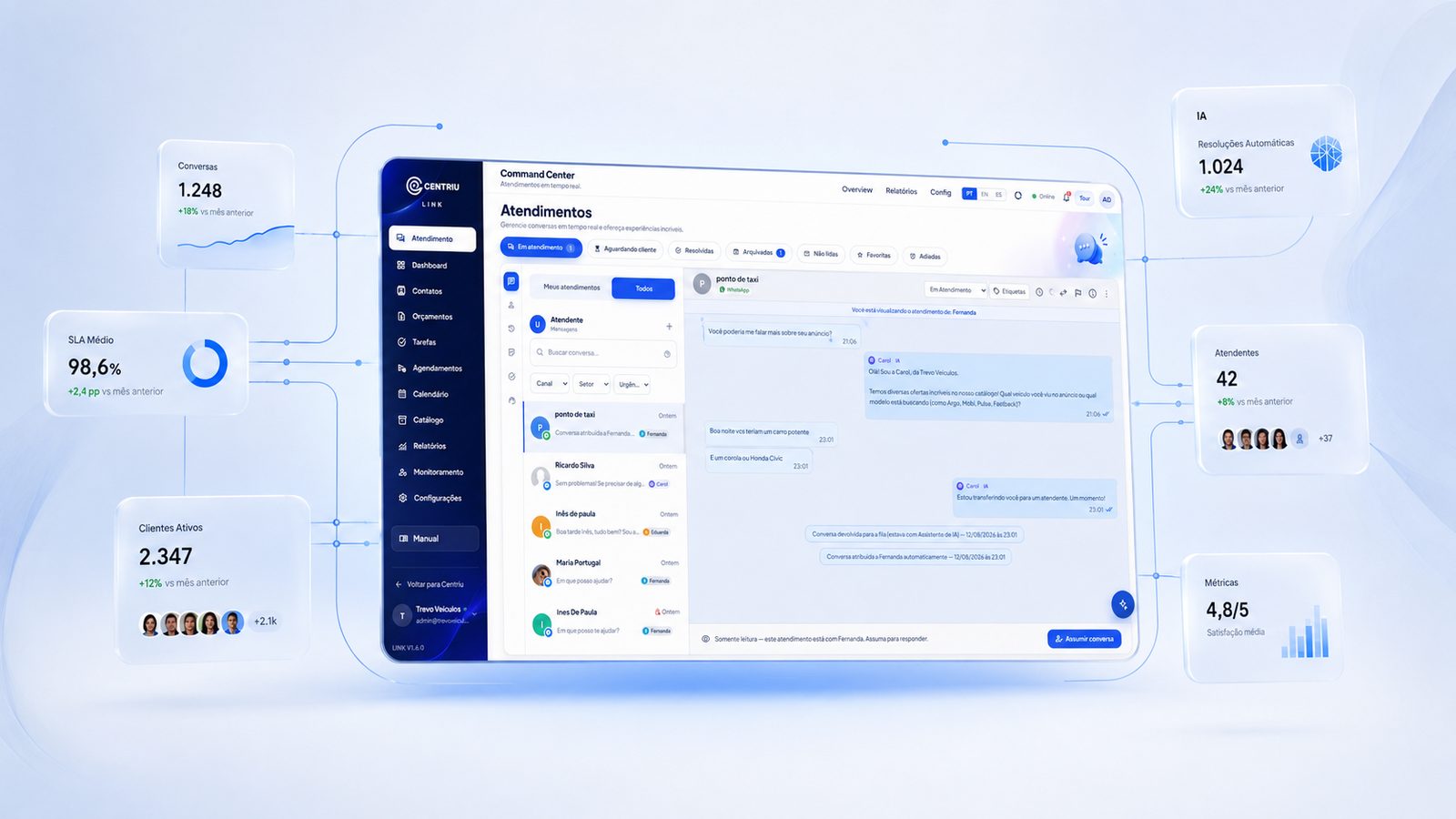
Painel ilustrativo do Sistema Centriu com sete frentes trabalhando: atendimento, comercial, operação, agentes, inteligência, conteúdo e marketing. Cada frente mostra o trabalho concluído ou o próximo passo.
Representação ilustrativa do trabalho em execução
Não é falta de ferramenta. É que cada ferramenta resolve um pedaço, e ninguém é dono do todo. O custo disso não aparece numa fatura — aparece no mês seguinte.
Sistemas que não se falam
O mesmo dado é digitado de novo — e cada cópia conta uma história diferente.
Dados duplicados
Ninguém sabe qual versão é a verdadeira na hora de decidir.
Conversas perdidas
O cliente repete o contexto a cada canal e a cada pessoa.
Tarefas espalhadas
O trabalho vive em planilhas, mensagens e na memória de alguém.
Decisões sem contexto
A escolha é feita com o recorte que estava à mão, não com o que importava.
Automações desconectadas
Cada ferramenta automatiza um pedaço e ninguém enxerga o todo.
Nenhum desses problemas se resolve comprando mais um software. Eles se resolvem quando a operação inteira passa a trabalhar sobre o mesmo contexto.
A Centriu não é uma coleção de produtos. É uma plataforma em que clientes, áreas e agentes leem e escrevem no mesmo lugar.
Cliente 360
Um contexto, não vários cadastros
Cada conversa, tarefa, campanha, cobrança e decisão fica ligada ao cliente e à operação — não a um sistema isolado.
As áreas abaixo são partes da mesma operação, não produtos separados. Elas compartilham conta, permissões e histórico.
A inteligência artificial da Centriu participa da operação: entende contexto, prepara trabalho, executa rotinas e pede aprovação quando importa.
Lê a operação, o cliente e o histórico antes de propor qualquer coisa.
Redige, organiza, calcula e deixa pronto para revisão humana.
Roda o que é repetitivo dentro dos limites definidos pela empresa.
Cruza áreas, identifica prioridade e mostra o motivo da recomendação.
O que é sensível passa por uma pessoa antes de valer. Sem exceção silenciosa.
Registra o que aconteceu e usa o resultado para melhorar a próxima decisão.
Uma plataforma, várias frentes de trabalho. Tudo no mesmo contexto, com a IA participando do que dá para acelerar.
CRM, pipeline, oportunidades, propostas, follow-up e automações.
WhatsApp, Instagram, Messenger, chat do site e e-mail no mesmo contexto.
Tarefas, responsáveis, prazos, aprovações, agenda e capacidade.
Contas, cobranças, caixa, fiscal, margem, IR, orçamento e inteligência econômica.
Planejar, produzir, aprovar, publicar e medir conteúdo e campanhas.
Painéis, alertas, previsões, recomendações e leitura executiva.
Rotinas executadas continuamente pela IA com controle e aprovação.
Diagnóstico, estratégia, transformação, acompanhamento e especialistas.
A Centriu faz sentido quando o volume aumenta e a estrutura precisa acompanhar. Não é sobre setor nem tamanho: é sobre a operação conseguir sustentar o próximo estágio.
As vendas crescem, mas o processo não acompanha.
As áreas trabalham separadas e o cliente sente.
A operação depende de pessoas específicas.
O financeiro ficou complexo e o caixa perde visibilidade.
O atendimento cresce em volume e em canais.
A IA entra sem contexto, controle ou histórico.
Se a empresa ainda não começou a crescer, a Centriu também ajuda a preparar a estrutura para o primeiro salto.
Ver a Centriu funcionandoA Centriu combina tecnologia, inteligência, método e acompanhamento. A consultoria diagnostica, desenha, implanta e acompanha — com evidências, não com apresentação.
Diagnóstico e imersão na operação
Estratégia e prioridades
Roadmap de transformação
Desenho da arquitetura operacional
Implantação conduzida
Acompanhamento com evidências
Benchmarking e leitura de mercado
Especialistas, rede e inteligência coletiva
Uma conversa para entender onde a sua operação perde tempo, dinheiro ou capacidade — e o que a Centriu faria primeiro.
problema
"Sell more" and "use more AI" sound like opportunities. But neither one says what would actually change. They don't say for whom, or why now. A consulting team can nod along to either sentence in a meeting. They still have nothing to act on afterward. Centriu Oracle checks every opportunity statement against eight specific questions. It needs to answer what favorable situation exists. It needs to answer what problem it solves. It needs to answer what value it creates. It needs to answer for whom. It needs to answer over what period. It needs to answer under what condition. It needs to answer at what cost of doing nothing. It needs to answer what the next validation step is. It separately rejects seven named generic phrasings on sight. This includes the literal "sell more" and "use more AI" examples. An opportunity cannot be labeled commercial. This is for the client or for Centriu itself. It needs a server-enforced, written reason. This reason describes something the client actually said or did. It must show real buying intent. A perceived need alone is explicitly rejected. Confusing "the client needs this" with "the client wants to buy this" is a mistake. This mistake burns trust with a sales team. They are asked to chase something that was never really there.
An opportunity is easy to state vaguely. It is hard to state precisely. "Sell more" costs nothing to say. It commits to nothing specific. A genuinely useful opportunity statement has to name a real situation. It has to name a real beneficiary. It has to name a real cost of doing nothing. Under the pace of a client engagement, the vague version wins by default. This happens unless something actively pushes back on it. A second, separate failure mode compounds the first. Once an opportunity exists on paper, the temptation to call it "commercial" is strong. This means something the sales team should chase right now. This is true even when all that actually exists is a need the consultant perceived. It is not anything the client has said or done that shows they intend to buy.
An opportunity is easy to state vaguely. It is hard to state precisely. "Sell more" costs nothing to say. It commits to nothing specific. A genuinely useful opportunity statement has to name a real situation. It has to name a real beneficiary. It has to name a real cost of doing nothing. Under the pace of a client engagement, the vague version wins by default. This happens unless something actively pushes back on it. A second, separate failure mode compounds the first. Once an opportunity exists on paper, the temptation to call it "commercial" is strong. This means something the sales team should chase right now. This is true even when all that actually exists is a need the consultant perceived. It is not anything the client has said or done that shows they intend to buy.
Every opportunity statement is checked against eight required elements. These are the favorable situation that exists, the problem it solves, the value it creates, who benefits, over what period, under what condition, what doing nothing costs, and what the next validation step is. Each needs real content before it counts as present. Separately, the exact title text is checked against seven specific generic phrasings. These are named as inadequate on sight. This includes the literal "sell more," "use more AI," "build an app," "enter new markets," and "improve marketing" examples. The underlying method calls these out by name. A title matching any of them is flagged with the specific reason it fails to say anything actionable. On classification, the system enforces a rule directly in the save function itself. This is not just UI guidance. Choosing either commercial classification, for the client or for Centriu, throws a server-side error. This happens unless a written reason comes with it. This reason must describe specifically what the client said or did. It must show real buying intent, not merely a need the consultant identified. A separate, deliberately simple confidence calculation then scores the opportunity. Each of the eight required formulation elements present is worth one point. Evidence linked back to the structured diagnosis is worth two. There is no hidden weighting. This is specifically so a consultant can explain, in front of a client, exactly why a given opportunity's confidence is where it is.
An 8-question formulation check runs on every opportunity statement. It checks for favorable situation, problem, value, beneficiaries, period, condition, cost of inaction, and next validation step.
Seven named generic-phrasing patterns are checked word for word against the opportunity title. This matches the method's own examples of inadequate formulation.
A server-enforced rule is confirmed directly in the save function's own source. Commercial classification (for the client or for Centriu) is rejected without a written reason. This reason must describe actual client behavior, not a perceived need.
A simple, additive confidence score is used. It gives one point per required formulation element. It gives two points for linked diagnosis evidence. It is designed to be easy to explain in a client talk. It is different from the weighted, hard-capped risk-confidence score on another page.
The same formulation check and generic-phrasing scan run live. They run in the real-time creation dialog as the consultant types. They run again server-side on save. This is confirmed in both `opportunity-create-dialog.tsx` and `saveOpportunity()`.
Every opportunity has a rich origin trail. It can be traced back to a specific client meeting. It can be traced to a diagnosis finding. It can be traced to a structured assertion. It can even be traced to a specific risk it came from. It is never a floating, unsourced idea.
An opportunity register stops filling with vague phrases. These phrases sound promising but say nothing specific. Sales stops getting opportunities based only on a consultant's guess. A commercial label now always comes with a stated, checkable reason. This reason is based on something the client actually said or did. A confidence score stays clear and easy to explain. A consultant can show a client exactly why it is what it is. They do not present a confusing number.
An opportunity register stops filling with vague phrases. These phrases sound promising but say nothing specific. Sales stops getting opportunities based only on a consultant's guess. A commercial label now always comes with a stated, checkable reason. This reason is based on something the client actually said or did. A confidence score stays clear and easy to explain. A consultant can show a client exactly why it is what it is. They do not present a confusing number.
A consultant's first attempt at logging an opportunity reads simply "sell more to existing clients." The generic-phrasing check does not match this exact wording. But the formulation check flags five of the eight required elements as missing. There is no stated favorable situation. There is no named beneficiary group. There is no benefit period. There is no cost of inaction. There is no next validation step. The consultant revises: "Existing clients on the basic plan have grown their team size by 40% on average (favorable situation). But the plan's seat limit is starting to force manual workarounds (problem). Upgrading unlocks per-seat features worth an estimated 15% productivity gain (value). This is for the 12 clients currently over 80% of their seat limit (beneficiaries). This happens within this quarter's renewal cycle (period). The cost of not addressing this is those clients hitting a hard wall and churning at renewal (cost of inaction). The next step is a targeted email to those 12 accounts with a seat-usage report attached (validation step)." This version passes the formulation check as "adequate." When the consultant tries to classify it "commercial for Centriu," the system requires a reason. They cite a specific signal: three of the twelve accounts have already emailed asking about seat pricing. This is the kind of client action the rule requires. It is not just a guessed need.

An opportunity statement needs to answer eight questions. These are: what favorable situation exists, what problem it solves, what value it creates, who benefits, over what period, under what condition, what the cost of doing nothing is, and what the next validation step is.
No. The save function itself rejects a commercial classification. This happens without a written reason describing something the client actually said or did. This must show buying intent. A perceived need alone is explicitly not accepted.
No. The opportunity confidence score is a simple, additive point system. It gives one point per required formulation element. It gives two points for linked evidence. It is built for clarity in a client talk. The risk confidence score on a separate page uses seven weighted criteria with hard limits. These are different ways of scoring confidence. They serve the same idea of scoring confidence separately from value or severity.
The title is checked against seven named general patterns. If there is a match, it is flagged with the specific reason it fails to say anything useful. The opportunity is still saved with that flag. It is not rejected completely.
Yes. An opportunity can be linked to a specific client meeting. It can be linked to a diagnosis finding. It can be linked to a structured assertion. It can even be linked to a specific risk it came from. So it is never a floating, unsourced idea.
It is sold by subscription with a published starting price. The exact current values are on the central pricing page.
"Sell more" and "use more AI" sound like opportunities. But neither one says what would actually change. They don't say for whom, or why now. A consulting team can nod along to either sentence in a meeting. They still have nothing to act on afterward. Centriu Oracle checks every opportunity statement against eight specific questions. It needs to answer what favorable situation exists. It needs to answer what problem it solves. It needs to answer what value it creates. It needs to answer for whom. It needs to answer over what period. It needs to answer under what condition. It needs to answer at what cost of doing nothing. It needs to answer what the next validation step is. It separately rejects seven named generic phrasings on sight. This includes the literal "sell more" and "use more AI" examples. An opportunity cannot be labeled commercial. This is for the client or for Centriu itself. It needs a server-enforced, written reason. This reason describes something the client actually said or did. It must show real buying intent. A perceived need alone is explicitly rejected. Confusing "the client needs this" with "the client wants to buy this" is a mistake. This mistake burns trust with a sales team. They are asked to chase something that was never really there.