
Entende o contexto
Lê a operação, o cliente e o histórico antes de propor qualquer coisa.
Vendas, marketing, atendimento, operação, financeiro e inteligência trabalhando sobre o mesmo contexto — para sua empresa ganhar escala sem perder controle.
Sua empresa inteira. Uma operação. IA trabalhando.
Para empresas de qualquer setor que querem crescer com estrutura, controle e inteligência.
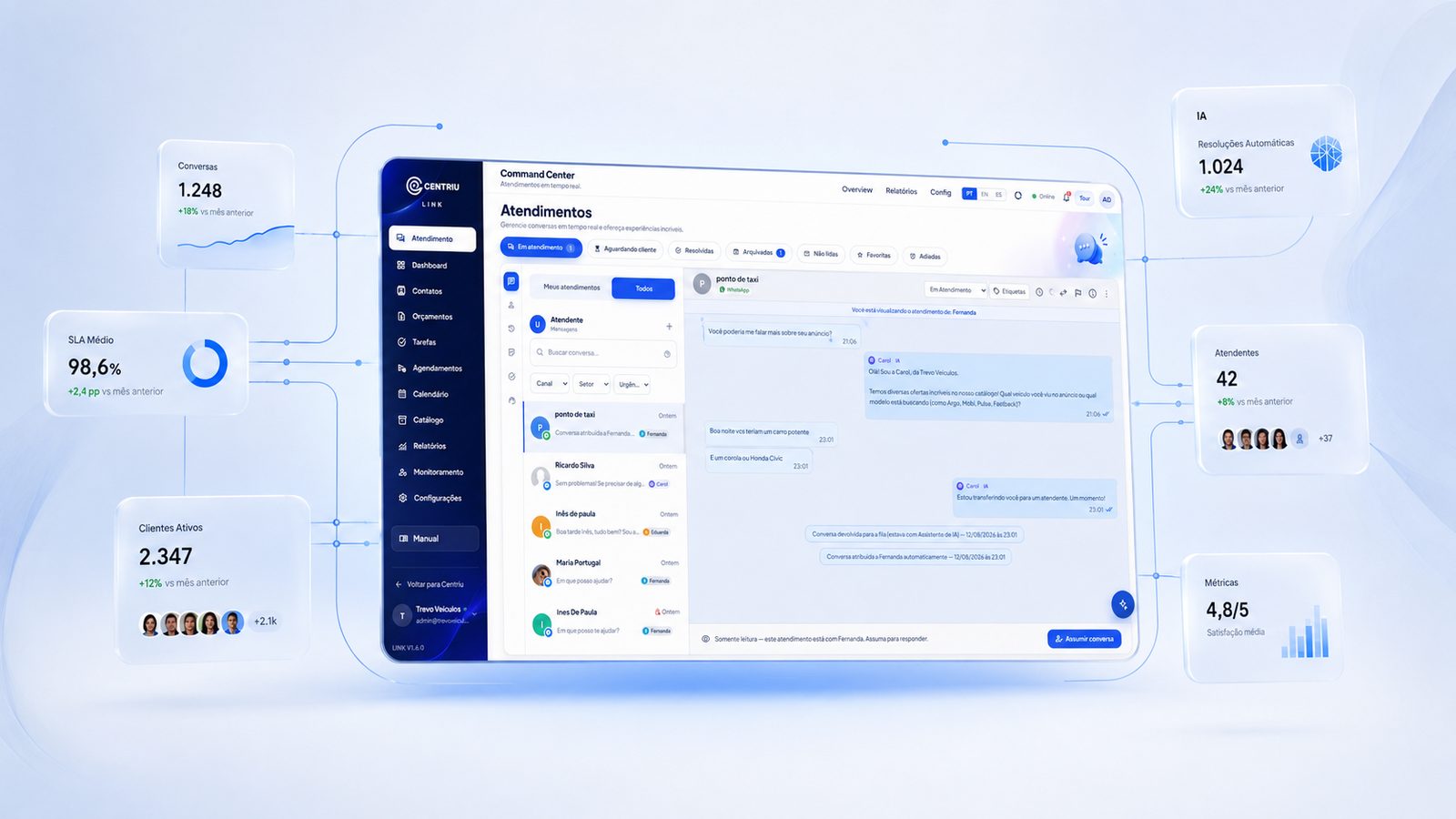
Painel ilustrativo do Sistema Centriu com sete frentes trabalhando: atendimento, comercial, operação, agentes, inteligência, conteúdo e marketing. Cada frente mostra o trabalho concluído ou o próximo passo.
Representação ilustrativa do trabalho em execução
Não é falta de ferramenta. É que cada ferramenta resolve um pedaço, e ninguém é dono do todo. O custo disso não aparece numa fatura — aparece no mês seguinte.
Sistemas que não se falam
O mesmo dado é digitado de novo — e cada cópia conta uma história diferente.
Dados duplicados
Ninguém sabe qual versão é a verdadeira na hora de decidir.
Conversas perdidas
O cliente repete o contexto a cada canal e a cada pessoa.
Tarefas espalhadas
O trabalho vive em planilhas, mensagens e na memória de alguém.
Decisões sem contexto
A escolha é feita com o recorte que estava à mão, não com o que importava.
Automações desconectadas
Cada ferramenta automatiza um pedaço e ninguém enxerga o todo.
Nenhum desses problemas se resolve comprando mais um software. Eles se resolvem quando a operação inteira passa a trabalhar sobre o mesmo contexto.
A Centriu não é uma coleção de produtos. É uma plataforma em que clientes, áreas e agentes leem e escrevem no mesmo lugar.
Cliente 360
Um contexto, não vários cadastros
Cada conversa, tarefa, campanha, cobrança e decisão fica ligada ao cliente e à operação — não a um sistema isolado.
As áreas abaixo são partes da mesma operação, não produtos separados. Elas compartilham conta, permissões e histórico.
A inteligência artificial da Centriu participa da operação: entende contexto, prepara trabalho, executa rotinas e pede aprovação quando importa.
Lê a operação, o cliente e o histórico antes de propor qualquer coisa.
Redige, organiza, calcula e deixa pronto para revisão humana.
Roda o que é repetitivo dentro dos limites definidos pela empresa.
Cruza áreas, identifica prioridade e mostra o motivo da recomendação.
O que é sensível passa por uma pessoa antes de valer. Sem exceção silenciosa.
Registra o que aconteceu e usa o resultado para melhorar a próxima decisão.
Uma plataforma, várias frentes de trabalho. Tudo no mesmo contexto, com a IA participando do que dá para acelerar.
CRM, pipeline, oportunidades, propostas, follow-up e automações.
WhatsApp, Instagram, Messenger, chat do site e e-mail no mesmo contexto.
Tarefas, responsáveis, prazos, aprovações, agenda e capacidade.
Contas, cobranças, caixa, fiscal, margem, IR, orçamento e inteligência econômica.
Planejar, produzir, aprovar, publicar e medir conteúdo e campanhas.
Painéis, alertas, previsões, recomendações e leitura executiva.
Rotinas executadas continuamente pela IA com controle e aprovação.
Diagnóstico, estratégia, transformação, acompanhamento e especialistas.
A Centriu faz sentido quando o volume aumenta e a estrutura precisa acompanhar. Não é sobre setor nem tamanho: é sobre a operação conseguir sustentar o próximo estágio.
As vendas crescem, mas o processo não acompanha.
As áreas trabalham separadas e o cliente sente.
A operação depende de pessoas específicas.
O financeiro ficou complexo e o caixa perde visibilidade.
O atendimento cresce em volume e em canais.
A IA entra sem contexto, controle ou histórico.
Se a empresa ainda não começou a crescer, a Centriu também ajuda a preparar a estrutura para o primeiro salto.
Ver a Centriu funcionandoA Centriu combina tecnologia, inteligência, método e acompanhamento. A consultoria diagnostica, desenha, implanta e acompanha — com evidências, não com apresentação.
Diagnóstico e imersão na operação
Estratégia e prioridades
Roadmap de transformação
Desenho da arquitetura operacional
Implantação conduzida
Acompanhamento com evidências
Benchmarking e leitura de mercado
Especialistas, rede e inteligência coletiva
Uma conversa para entender onde a sua operação perde tempo, dinheiro ou capacidade — e o que a Centriu faria primeiro.
problema
Portfolio-wide report batch generation, through Centriu Atlas, replaces opening the same report modal one client at a time by letting one call generate — and, if requested, immediately send — reports for up to 40 clients at once, processed three at a time rather than all simultaneously or one by one. Each client's outcome comes back individually: generated, already existed, or failed, each with its own message, so a team can see exactly which reports from a batch of thirty actually went out and which need a second look, instead of a single pass/fail answer for the whole run.

Generating a single client's report is a small task; generating the same report for every active client in a real agency roster, one modal at a time, every single month, is not — it is the same small task multiplied by however many clients are on the books, with no way to tell, partway through, which ones are already done and which ones still need attention.
Generating a single client's report is a small task; generating the same report for every active client in a real agency roster, one modal at a time, every single month, is not — it is the same small task multiplied by however many clients are on the books, with no way to tell, partway through, which ones are already done and which ones still need attention.
One call accepts either a specific list of client IDs or, when none is given, every active client in the organization, along with the month and year to generate for and whether to also send once generated. The batch is capped at 40 clients per call — an explicit, documented ceiling chosen so a batch always finishes within the request's time budget rather than being cut off partway through — and is additionally rate-limited to 3 batch runs per rolling 5-minute window per organization, so a batch cannot be re-triggered by accident moments after the last one started.
Clients are processed in groups of three at a time, not all at once and not strictly one by one — a deliberate middle ground between finishing quickly and not overloading the database or the AI narrative provider's own rate limit. Each client's result comes back individually: a successful generation, an "already exists" outcome when that period was already generated (worded as informational, not as an error, since a batch of thirty should not look thirty times worse than it is because half the reports were already done), a specific failure message, and — when sending was requested — whether the send itself succeeded, including the number of recipients it actually reached.
One call generating (and optionally sending) reports for a specific client list or the organization's entire active roster.
A hard cap of 40 clients per batch, with an explicit rejection message stating the limit when it is exceeded, rather than silently truncating the list.
Concurrency of 3 clients processed at a time — fast enough to finish a real roster within the request's time budget, throttled enough to respect the AI narrative provider's own rate limit.
A dedicated rate limit of 3 batch runs per rolling 5 minutes per organization, independent of the per-client concurrency.
Per-client, individually reported outcomes — generated, already existed, or failed — each with its own message, never a single pass/fail for the whole batch.
An optional immediate send per client right after generation, with its own success/failure reported alongside the generation result.
Month-end reporting for a whole client roster stops being a linear sequence of identical manual steps and becomes a single triggered run with a clear, itemized outcome. A partial failure in a batch of thirty is visible as exactly what it is — one specific client with one specific reason — instead of an ambiguous all-or-nothing result that leaves a team re-checking everyone to find the one that actually needs attention.
Month-end reporting for a whole client roster stops being a linear sequence of identical manual steps and becomes a single triggered run with a clear, itemized outcome. A partial failure in a batch of thirty is visible as exactly what it is — one specific client with one specific reason — instead of an ambiguous all-or-nothing result that leaves a team re-checking everyone to find the one that actually needs attention.
An operations lead triggers a batch for the organization's 30 active clients at month-end, with sending turned on. The batch processes them three at a time: 26 generate and send successfully, 3 already had a report for that period from an earlier manual run (reported as "already existed," not as failures), and 1 fails because that client has no report recipients registered yet. The response lists all 30 outcomes individually, so the operations lead fixes the one real gap — adding a recipient for that client — without needing to re-check the other 29.
Up to 40. A batch larger than that is rejected outright with the limit stated, rather than silently processing part of the list.
No — they are processed in groups of 3, a deliberate balance between finishing quickly and not overwhelming the database or the AI narrative provider's own rate limit.
It is reported individually with its own failure message; the rest of the batch continues and is unaffected.
Yes — an optional flag sends each report immediately after it generates, with its own send outcome reported alongside the generation result.
Up to 3 batch runs per rolling 5 minutes per organization — an independent rate limit on top of the per-client concurrency.
It is sold with tiered plans, starting at a published entry price; AI usage has a fail-closed ceiling per plan, measured over a 5-hour and a 7-day window — current prices are on the central pricing page.
Portfolio-wide report batch generation, through Centriu Atlas, replaces opening the same report modal one client at a time by letting one call generate — and, if requested, immediately send — reports for up to 40 clients at once, processed three at a time rather than all simultaneously or one by one. Each client's outcome comes back individually: generated, already existed, or failed, each with its own message, so a team can see exactly which reports from a batch of thirty actually went out and which need a second look, instead of a single pass/fail answer for the whole run.