
Entende o contexto
Lê a operação, o cliente e o histórico antes de propor qualquer coisa.
Vendas, marketing, atendimento, operação, financeiro e inteligência trabalhando sobre o mesmo contexto — para sua empresa ganhar escala sem perder controle.
Sua empresa inteira. Uma operação. IA trabalhando.
Para empresas de qualquer setor que querem crescer com estrutura, controle e inteligência.
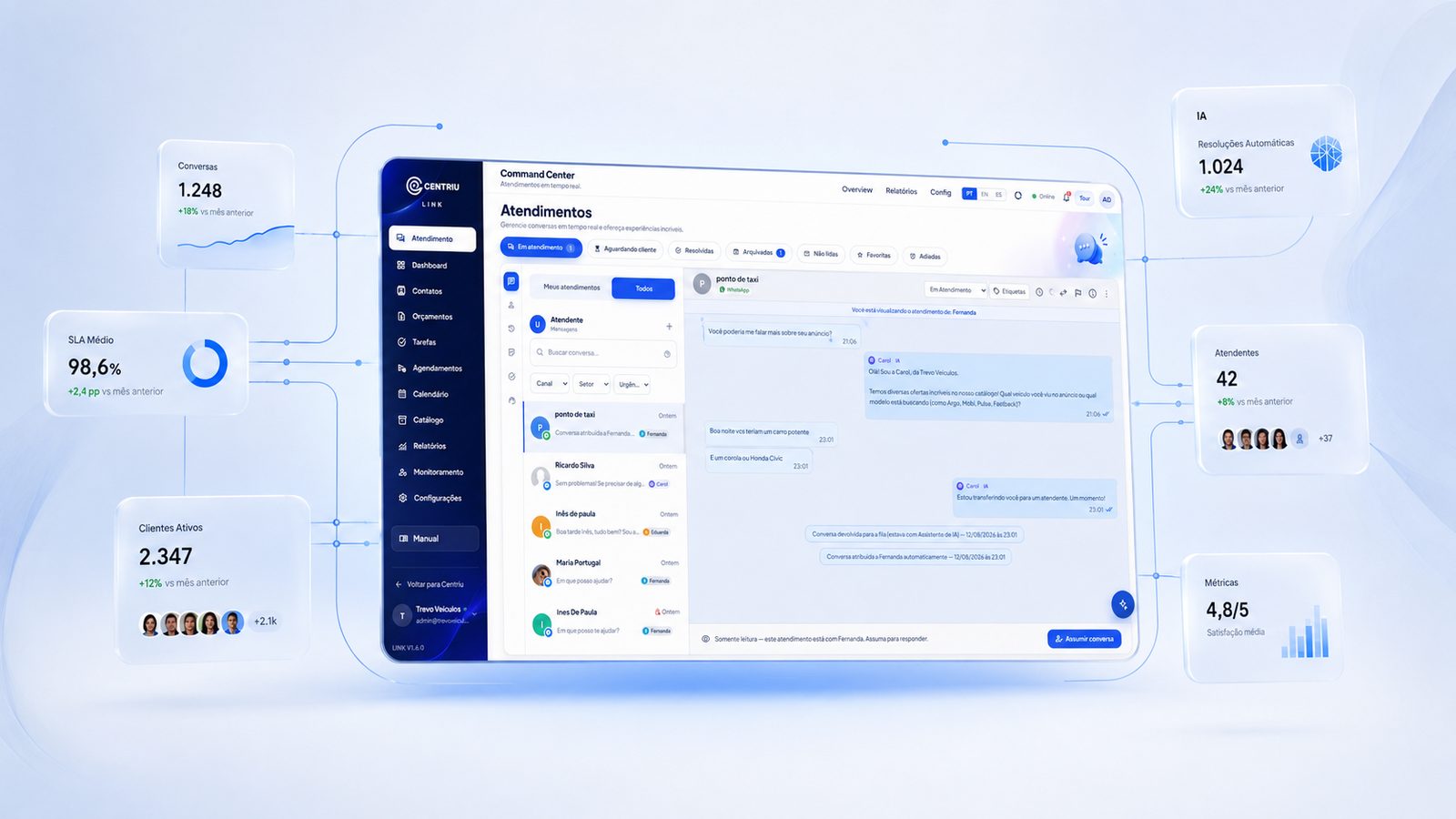
Painel ilustrativo do Sistema Centriu com sete frentes trabalhando: atendimento, comercial, operação, agentes, inteligência, conteúdo e marketing. Cada frente mostra o trabalho concluído ou o próximo passo.
Representação ilustrativa do trabalho em execução
Não é falta de ferramenta. É que cada ferramenta resolve um pedaço, e ninguém é dono do todo. O custo disso não aparece numa fatura — aparece no mês seguinte.
Sistemas que não se falam
O mesmo dado é digitado de novo — e cada cópia conta uma história diferente.
Dados duplicados
Ninguém sabe qual versão é a verdadeira na hora de decidir.
Conversas perdidas
O cliente repete o contexto a cada canal e a cada pessoa.
Tarefas espalhadas
O trabalho vive em planilhas, mensagens e na memória de alguém.
Decisões sem contexto
A escolha é feita com o recorte que estava à mão, não com o que importava.
Automações desconectadas
Cada ferramenta automatiza um pedaço e ninguém enxerga o todo.
Nenhum desses problemas se resolve comprando mais um software. Eles se resolvem quando a operação inteira passa a trabalhar sobre o mesmo contexto.
A Centriu não é uma coleção de produtos. É uma plataforma em que clientes, áreas e agentes leem e escrevem no mesmo lugar.
Cliente 360
Um contexto, não vários cadastros
Cada conversa, tarefa, campanha, cobrança e decisão fica ligada ao cliente e à operação — não a um sistema isolado.
As áreas abaixo são partes da mesma operação, não produtos separados. Elas compartilham conta, permissões e histórico.
A inteligência artificial da Centriu participa da operação: entende contexto, prepara trabalho, executa rotinas e pede aprovação quando importa.
Lê a operação, o cliente e o histórico antes de propor qualquer coisa.
Redige, organiza, calcula e deixa pronto para revisão humana.
Roda o que é repetitivo dentro dos limites definidos pela empresa.
Cruza áreas, identifica prioridade e mostra o motivo da recomendação.
O que é sensível passa por uma pessoa antes de valer. Sem exceção silenciosa.
Registra o que aconteceu e usa o resultado para melhorar a próxima decisão.
Uma plataforma, várias frentes de trabalho. Tudo no mesmo contexto, com a IA participando do que dá para acelerar.
CRM, pipeline, oportunidades, propostas, follow-up e automações.
WhatsApp, Instagram, Messenger, chat do site e e-mail no mesmo contexto.
Tarefas, responsáveis, prazos, aprovações, agenda e capacidade.
Contas, cobranças, caixa, fiscal, margem, IR, orçamento e inteligência econômica.
Planejar, produzir, aprovar, publicar e medir conteúdo e campanhas.
Painéis, alertas, previsões, recomendações e leitura executiva.
Rotinas executadas continuamente pela IA com controle e aprovação.
Diagnóstico, estratégia, transformação, acompanhamento e especialistas.
A Centriu faz sentido quando o volume aumenta e a estrutura precisa acompanhar. Não é sobre setor nem tamanho: é sobre a operação conseguir sustentar o próximo estágio.
As vendas crescem, mas o processo não acompanha.
As áreas trabalham separadas e o cliente sente.
A operação depende de pessoas específicas.
O financeiro ficou complexo e o caixa perde visibilidade.
O atendimento cresce em volume e em canais.
A IA entra sem contexto, controle ou histórico.
Se a empresa ainda não começou a crescer, a Centriu também ajuda a preparar a estrutura para o primeiro salto.
Ver a Centriu funcionandoA Centriu combina tecnologia, inteligência, método e acompanhamento. A consultoria diagnostica, desenha, implanta e acompanha — com evidências, não com apresentação.
Diagnóstico e imersão na operação
Estratégia e prioridades
Roadmap de transformação
Desenho da arquitetura operacional
Implantação conduzida
Acompanhamento com evidências
Benchmarking e leitura de mercado
Especialistas, rede e inteligência coletiva
Uma conversa para entender onde a sua operação perde tempo, dinheiro ou capacidade — e o que a Centriu faria primeiro.
problema
The expensive mistake in a delivery operation is not a badly executed piece of work. It is a well-executed piece of work that should never have been produced. Centriu Run puts a gate in front of production. A demand marked as requiring strategic review cannot be sent to production until a review returns a verdict. The send action is disabled. It shows the specific reason it is blocked. A verdict of "approved with adjustments" keeps it blocked. This lasts until someone explicitly confirms they read the recommendations. An administrator can override the gate. But the override refuses an empty justification. It stores the reason. The demand then permanently displays that it was released manually and why.

Every delivery operation has a review step. In most of them it sits at the end. The work is made. Then someone senior looks at it. Then it goes to the client. That placement is understandable. It is also the most expensive possible position for a review. This is because by the time a piece of work exists, the cost of it being the wrong piece of work has already been paid. The judgement that would have saved the money had to happen days earlier. This judgment is: is this the right thing to make for this client, right now? It had to happen at the moment the demand came in. In most operations it happens informally, in someone's head, on a good day, when there is time.
Every delivery operation has a review step. In most of them it sits at the end. The work is made. Then someone senior looks at it. Then it goes to the client. That placement is understandable. It is also the most expensive possible position for a review. This is because by the time a piece of work exists, the cost of it being the wrong piece of work has already been paid. The judgement that would have saved the money had to happen days earlier. This judgment is: is this the right thing to make for this client, right now? It had to happen at the moment the demand came in. In most operations it happens informally, in someone's head, on a good day, when there is time.
A demand carries a flag. This flag says whether strategic review is required. It also has a status that moves through a nine-state workflow. These states are: awaiting review, under review, approved, approved with adjustments, rejected, in refinement by the team, resubmitted, released for production, and released manually by an administrator. The review itself is an AI analysis. It runs against four layers of context. These are: the client's own records inside Run, the team's initial idea, the most recent monthly trends report, and the seasonal calendar for the current month. It returns a structured verdict. This verdict includes a numeric strategic score out of ten, an executive diagnosis, and one of three final decisions. These decisions are: approved for production, approved with adjustments, or rejected pending refinement. Until the status is approved, released for production, or released manually, the send-to-production action is disabled. It states the specific reason. For example: the review has not run, the analysis is in progress, the demand was rejected and needs refining, or the recommendations have not yet been acknowledged. That last case is deliberate. An "approved with adjustments" verdict is not enough on its own. Someone has to confirm they read the recommendations. This stamps an acknowledgement before production opens. The override exists for genuine urgency. It is designed to leave a mark. An empty justification is refused outright. The reason is stored. The demand card afterwards displays that it was released manually along with the stated reason. Every transition is added to a separate event record. This includes: analysis requested, completed or failed, adjustments acknowledged, manual override, resubmitted, status changed, released for production. Each new analysis of the same demand is stored as its own version. It does not overwrite the previous one.
A per-demand flag marks if strategic review is needed before production.
A nine-state review workflow. It goes from awaiting review to released for production or released manually.
An AI review runs against four context layers. These are: the client's records in Run, the team's initial idea, the most recent monthly trends report, and the current month's seasonal calendar.
A structured verdict is given. This includes a numeric strategic score out of ten, an executive diagnosis, and one of three final decisions.
The send-to-production action is disabled when the gate is closed. It shows the specific blocking reason. It does not show a general refusal.
There is an explicit acknowledgement step for an "approved with adjustments" verdict. Production stays closed until someone confirms they read the recommendations. The confirmation is timestamped.
An administrator override refuses an empty justification. It stores the written reason. It permanently displays on the demand that it was released manually and why.
An event record is added for every transition. This covers eight event types.
Analyses are versioned. A re-run is stored as a new version of the same demand's review. It is not a replacement.
There is a request rate limit on the analysis. The organization scope is always from the verified client record. It is not from the incoming request.
The structural change is that the strategic question stops being optional. It stops depending on whether someone had time to ask it. Weak ideas are caught before production capacity is spent on them. This is better than catching them after. Recommendations get read because production waits on the reading. The exceptions, which are the genuinely urgent overrides, become a written, attributable record. They are not a conversation nobody can reconstruct. Centriu does not attach a figure to what that saves. It depends entirely on how much production capacity an operation has. It also depends on how often the wrong work gets made.
The structural change is that the strategic question stops being optional. It stops depending on whether someone had time to ask it. Weak ideas are caught before production capacity is spent on them. This is better than catching them after. Recommendations get read because production waits on the reading. The exceptions, which are the genuinely urgent overrides, become a written, attributable record. They are not a conversation nobody can reconstruct. Centriu does not attach a figure to what that saves. It depends entirely on how much production capacity an operation has. It also depends on how often the wrong work gets made.
A client asks for a campaign concept. They want it to go into production immediately. The demand is created in Run. Strategic review is required for this client. So, it lands as awaiting review. The producer opens it. They find the send-to-production button disabled. The reason is stated plainly. It is not left to guess.
The review runs. It returns "approved with adjustments." This means a decent score. It also means a diagnosis of good-with-adjustments. There are three specific recommendations about the angle. Production is still closed. It opens only after someone clicks to confirm they read the recommendations. This stamps the acknowledgement onto the demand. The producer reads them. They adjust the brief. Then they proceed.
A second demand the same afternoon comes back rejected. It says to refine before producing. The account manager believes the client's deadline truly justifies going ahead anyway. She uses the administrator override. This will not accept an empty box. She writes the reason. The demand moves to released manually. From that point forward, the card shows both that it was released manually and the reason given. Nothing was blocked absolutely. Nothing was waved through invisibly.
A demand flagged as requiring strategic review stays blocked. This lasts until its status is approved, released for production, or released manually. The send action shows the specific reason it is currently blocked.
No. Production stays closed until someone explicitly confirms they read the recommendations. This stamps a timestamped acknowledgement on the demand.
Yes, and it leaves a mark. An empty justification is refused. The written reason is stored. The demand permanently displays that it was released manually along with that reason.
Four layers of context are reviewed. These are: the client's own records in Run, the team's initial idea, the most recent monthly trends report, and the current month's seasonal calendar.
The review returns a numeric strategic score out of ten. It also gives an executive diagnosis. And it provides one of three final decisions: approved for production, approved with adjustments, or rejected pending refinement.
Yes. Every transition is added to an event record. This covers eight event types. Each re-run of the analysis is stored as its own version. It does not replace the previous one.
It is sold by subscription with a published starting price. Exact current values are on the central pricing page.
The expensive mistake in a delivery operation is not a badly executed piece of work. It is a well-executed piece of work that should never have been produced. Centriu Run puts a gate in front of production. A demand marked as requiring strategic review cannot be sent to production until a review returns a verdict. The send action is disabled. It shows the specific reason it is blocked. A verdict of "approved with adjustments" keeps it blocked. This lasts until someone explicitly confirms they read the recommendations. An administrator can override the gate. But the override refuses an empty justification. It stores the reason. The demand then permanently displays that it was released manually and why.