
Entende o contexto
Lê a operação, o cliente e o histórico antes de propor qualquer coisa.
Vendas, marketing, atendimento, operação, financeiro e inteligência trabalhando sobre o mesmo contexto — para sua empresa ganhar escala sem perder controle.
Sua empresa inteira. Uma operação. IA trabalhando.
Para empresas de qualquer setor que querem crescer com estrutura, controle e inteligência.
Painel ilustrativo do Sistema Centriu com sete frentes trabalhando: atendimento, comercial, operação, agentes, inteligência, conteúdo e marketing. Cada frente mostra o trabalho concluído ou o próximo passo.
Representação ilustrativa do trabalho em execução
Não é falta de ferramenta. É que cada ferramenta resolve um pedaço, e ninguém é dono do todo. O custo disso não aparece numa fatura — aparece no mês seguinte.
Sistemas que não se falam
O mesmo dado é digitado de novo — e cada cópia conta uma história diferente.
Dados duplicados
Ninguém sabe qual versão é a verdadeira na hora de decidir.
Conversas perdidas
O cliente repete o contexto a cada canal e a cada pessoa.
Tarefas espalhadas
O trabalho vive em planilhas, mensagens e na memória de alguém.
Decisões sem contexto
A escolha é feita com o recorte que estava à mão, não com o que importava.
Automações desconectadas
Cada ferramenta automatiza um pedaço e ninguém enxerga o todo.
Nenhum desses problemas se resolve comprando mais um software. Eles se resolvem quando a operação inteira passa a trabalhar sobre o mesmo contexto.
A Centriu não é uma coleção de produtos. É uma plataforma em que clientes, áreas e agentes leem e escrevem no mesmo lugar.
Cliente 360
Um contexto, não vários cadastros
Cada conversa, tarefa, campanha, cobrança e decisão fica ligada ao cliente e à operação — não a um sistema isolado.
As áreas abaixo são partes da mesma operação, não produtos separados. Elas compartilham conta, permissões e histórico.
A inteligência artificial da Centriu participa da operação: entende contexto, prepara trabalho, executa rotinas e pede aprovação quando importa.
Lê a operação, o cliente e o histórico antes de propor qualquer coisa.
Redige, organiza, calcula e deixa pronto para revisão humana.
Roda o que é repetitivo dentro dos limites definidos pela empresa.
Cruza áreas, identifica prioridade e mostra o motivo da recomendação.
O que é sensível passa por uma pessoa antes de valer. Sem exceção silenciosa.
Registra o que aconteceu e usa o resultado para melhorar a próxima decisão.
Uma plataforma, várias frentes de trabalho. Tudo no mesmo contexto, com a IA participando do que dá para acelerar.
CRM, pipeline, oportunidades, propostas, follow-up e automações.
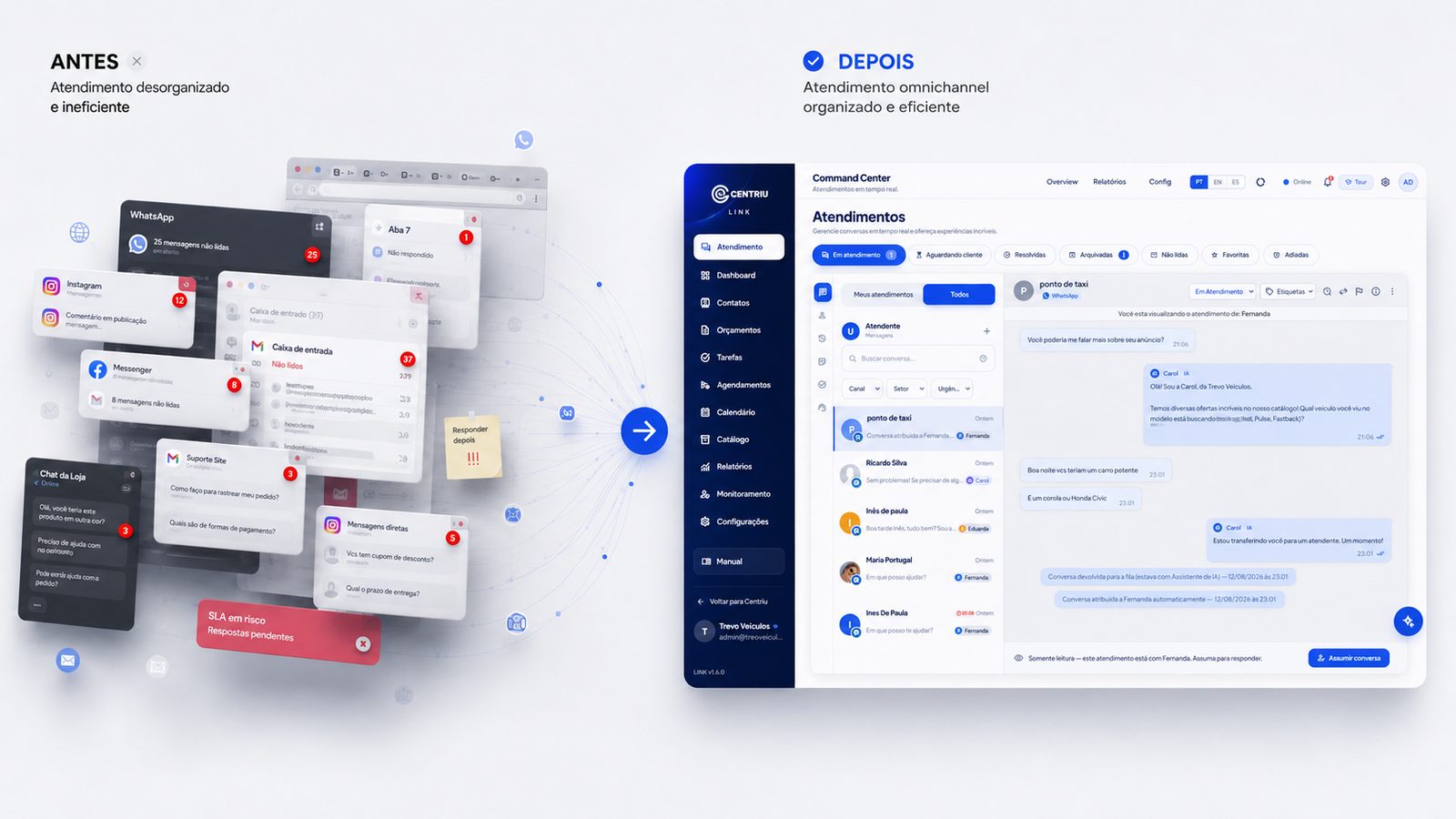
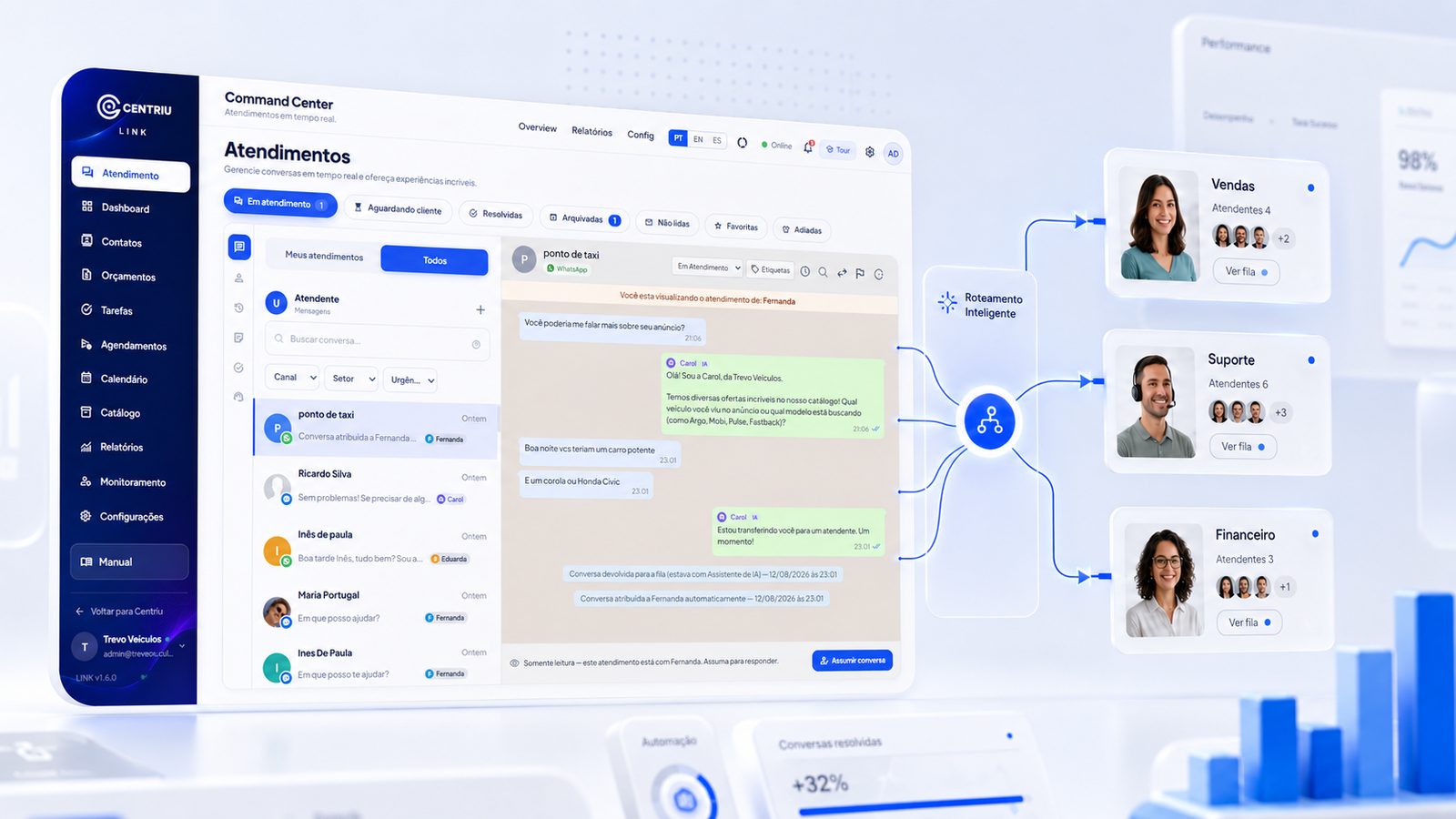
WhatsApp, Instagram, Messenger, chat do site e e-mail no mesmo contexto.
Tarefas, responsáveis, prazos, aprovações, agenda e capacidade.
Contas, cobranças, caixa, fiscal, margem, IR, orçamento e inteligência econômica.
Planejar, produzir, aprovar, publicar e medir conteúdo e campanhas.
Painéis, alertas, previsões, recomendações e leitura executiva.
Rotinas executadas continuamente pela IA com controle e aprovação.
Diagnóstico, estratégia, transformação, acompanhamento e especialistas.
A Centriu faz sentido quando o volume aumenta e a estrutura precisa acompanhar. Não é sobre setor nem tamanho: é sobre a operação conseguir sustentar o próximo estágio.
As vendas crescem, mas o processo não acompanha.
As áreas trabalham separadas e o cliente sente.
A operação depende de pessoas específicas.
O financeiro ficou complexo e o caixa perde visibilidade.
O atendimento cresce em volume e em canais.
A IA entra sem contexto, controle ou histórico.
Se a empresa ainda não começou a crescer, a Centriu também ajuda a preparar a estrutura para o primeiro salto.
Ver a Centriu funcionandoA Centriu combina tecnologia, inteligência, método e acompanhamento. A consultoria diagnostica, desenha, implanta e acompanha — com evidências, não com apresentação.
Diagnóstico e imersão na operação
Estratégia e prioridades
Roadmap de transformação
Desenho da arquitetura operacional
Implantação conduzida
Acompanhamento com evidências
Benchmarking e leitura de mercado
Especialistas, rede e inteligência coletiva
Uma conversa para entender onde a sua operação perde tempo, dinheiro ou capacidade — e o que a Centriu faria primeiro.
problema
Multiplying probability by impact is the textbook way to score a risk. But it assumes two risks with the same product deserve the same attention. One risk may happen tomorrow with no warning. The other may take a year to unfold with plenty of notice. Centriu Oracle scores criticality from seven weighted criteria. These are probability, impact, speed of materialization, detectability, reversibility, degree of control, and how many other records depend on this risk not happening. It applies hard floors that can only ever push the score UP. These include existential impact, a critical impact with at least moderate probability, an irreversible effect with high-or-greater impact, imminent probability with moderate-or-greater impact, immediate materialization with zero advance detectability, five named dimensions (privacy, security, legal, data, continuity) that never get diluted by averaging, and exposure declared outside an organization's stated risk tolerance. A separate, independently capped confidence score answers a different question. It asks how much to trust the assessment itself, not how severe the risk is. A risk can be alarming and still rest on thin evidence. Collapsing those two questions into one number is the mistake the methodology is built to prevent.
A simple probability-times-impact score treats every risk with the same numeric product identically. A slow-moving, easily detected risk with plenty of warning time behaves nothing like a sudden, invisible one with the same nominal score. A team can prepare for the first and gets blindsided by the second. A second problem hides inside any single risk score. A risk can look severe on paper while resting on almost no real evidence. Or it can look mild while being backed by solid data. Conflating 'how bad' with 'how sure' produces a number that looks precise and is not defensible under questioning.
A simple probability-times-impact score treats every risk with the same numeric product identically. A slow-moving, easily detected risk with plenty of warning time behaves nothing like a sudden, invisible one with the same nominal score. A team can prepare for the first and gets blindsided by the second. A second problem hides inside any single risk score. A risk can look severe on paper while resting on almost no real evidence. Or it can look mild while being backed by solid data. Conflating 'how bad' with 'how sure' produces a number that looks precise and is not defensible under questioning.
Inherent criticality is calculated BEFORE any controls are considered. This is done deliberately, so a control can never quietly lower the starting point. It comes from seven weighted criteria: probability and impact (weight 3 each), materialization speed, detectability and reversibility (weight 2 each), and degree of control plus how many other records depend on this risk (weight 1 each). These are combined into a single weighted percentage and mapped to one of five levels from low to extreme. On top of that weighted score, a set of hard floors can only ever raise the final level, never lower it. Each floor records its own explicit reason. Existential impact floors at 'critical.' A critical impact combined with at least moderate probability floors at 'high.' An irreversible effect combined with high-or-greater impact floors at 'high.' An imminent probability combined with moderate-or-greater impact floors at 'high.' Immediate materialization speed combined with zero advance detectability floors at 'high.' High-or-greater impact in one of five specific dimensions that never dilute by averaging (privacy, security, legal, data, continuity) floors at 'high.' Exposure declared outside a stated tolerance policy floors at 'high.' Only after inherent criticality is set does a documented control get evaluated. A control counts only if it is currently active, has actually been verified (not merely written down), and that verification is no older than 180 days. A stale verification is treated as no verification at all. Verified, effective controls can reduce the residual reading by at most ONE level. This is true no matter how many controls exist or how effective they individually are. This methodology scores residual exposure, never risk elimination. A completely separate confidence score is built from seven different weighted criteria. These are declared probability basis, linked evidence, anticipatory signals, tracked indicators with actual readings, assessed impact dimensions, a confirmed owner, and a scheduled review. This score answers 'how much should this specific assessment be trusted' rather than 'how bad is it.' It carries its own hard caps. Zero evidence, zero signals, and zero declared basis together cap confidence at the very lowest level. Zero evidence alone caps it at 'moderate' even if every other number would compute higher. The very top rating requires a human to have actually promoted the risk, not just a favorable score. A response evaluation separately flags 'monitor' as the sole strategy on a high-or-greater risk. This is for an irreversible or immediately-materializing risk with no contingency plan. 'Accept' is chosen for a severe risk without a recorded approver. When no organizational tolerance policy is on file, the tool states plainly that tolerance is undefined. It does not assume the exposure is acceptable by default.
A 7-criterion weighted criticality score (not a probability-times-impact multiplication), computed BEFORE controls are considered, confirmed directly in the scoring function's own source.
Seven distinct hard floors that can only ever raise the computed criticality level. Each floor records its own explicit stated reason in the output — never silently applied.
A verified-and-effective-only control model. A documented-but-unverified control counts as zero. A verification older than 180 days is automatically treated as unverified again.
A hard one-level cap on residual-exposure reduction. This is true regardless of how many effective controls exist. This is residual scoring, never risk elimination.
A completely separate, independently capped confidence-in-the-assessment score. This score is built from seven different criteria than criticality. It answers 'how much to trust this reading,' not 'how severe is it.'
An automated response-adequacy check. This check specifically flags 'monitor' as an inadequate sole response for a high-or-greater risk. It also flags a severe risk with no contingency plan.
An explicit 'tolerance undefined' state whenever no organizational risk-appetite policy is on file. This is instead of defaulting to an assumption of acceptability.
A hygiene pass confirming an owner is actually assigned (not just a job title). A review date is scheduled and not overdue. A high-or-greater risk has at least one real response strategy on file.
Confirmed in the engine's own source: nothing in this scoring layer changes the OFFICIAL assessment automatically. A recompute only writes when a person explicitly requests it. Neither Run nor Orbit signal-collectors can silently alter it.
A fast, hard-to-detect risk gets the elevated attention a slow, easy-to-watch one with the same nominal probability and impact does not automatically deserve. The score accounts for speed and detectability directly, not just probability and impact averaged together. A control someone wrote into a policy stops counting for anything until it is actually verified to work. That verification has an expiration built in. A severity number and a confidence number are never collapsed into one figure. This avoids hiding which of the two — 'how bad' or 'how sure' — is actually driving the reading a client is being shown.
A fast, hard-to-detect risk gets the elevated attention a slow, easy-to-watch one with the same nominal probability and impact does not automatically deserve. The score accounts for speed and detectability directly, not just probability and impact averaged together. A control someone wrote into a policy stops counting for anything until it is actually verified to work. That verification has an expiration built in. A severity number and a confidence number are never collapsed into one figure. This avoids hiding which of the two — 'how bad' or 'how sure' — is actually driving the reading a client is being shown.
Two risks are logged for the same client in the same week. The first is a slow, gradual decline in a key supplier's service quality. It has moderate probability, moderate impact, and is easily detectable through routine check-ins. This computes to a 'moderate' criticality with no floor applied. The second is a possible sudden regulatory change affecting the client's core offering. It is also rated moderate probability and moderate impact on paper. But it has immediate materialization speed and a 'somente_apos_impacto' (only perceptible after the fact) detectability rating. This trips the immediate-velocity-plus-undetectable floor and is elevated to 'high.' This is because there is no warning window to react in. Even though the raw probability and impact ratings started out identical to the first risk. A documented mitigation control exists for the second risk. But it was never actually verified. The residual reading stays at 'high,' unchanged from the inherent one. This is because an unverified control counts as no control at all.
Because a moderate-probability, moderate-impact risk that would materialize immediately with no advance warning needs more attention. This is more than one with the same nominal score that would unfold slowly with plenty of notice. A simple multiplication cannot represent that difference. So criticality instead uses seven weighted criteria plus hard floors.
No. A control only counts if it is currently active and has been independently verified within the last 180 days. A control that is only written into a policy, or whose verification is stale, counts as no control at all.
By at most one criticality level, regardless of how many verified, effective controls exist. The methodology is explicit that this produces a residual reading, never a claim that the risk has been eliminated.
No, deliberately. Confidence answers 'how much should this specific assessment be trusted.' It is built from different criteria (evidence, signals, indicators, a confirmed owner) than criticality. Criticality answers 'how bad is it.' A risk can be rated severe with low confidence, or mild with high confidence.
The tool states explicitly that tolerance is undefined. Leadership needs to declare an appetite before any exposure can be called acceptable. It never defaults to assuming a reading is within tolerance.
It is sold by subscription with a published starting price. Exact current values are on the central pricing page.
Multiplying probability by impact is the textbook way to score a risk. But it assumes two risks with the same product deserve the same attention. One may happen tomorrow with no warning. The other may take a year to unfold with plenty of notice. Centriu Oracle scores criticality from seven weighted criteria. These are probability, impact, speed of materialization, detectability, reversibility, degree of control, and how many other records depend on this risk not happening. It applies hard floors that can only ever push the score UP. These include existential impact, a critical impact with at least moderate probability, an irreversible effect with high-or-greater impact, imminent probability with moderate-or-greater impact, immediate materialization with zero advance detectability, five named dimensions (privacy, security, legal, data, continuity) that never get diluted by averaging, and exposure declared outside an organization's stated risk tolerance. A separate, independently capped confidence score answers a different question. It asks how much to trust the assessment itself, not how severe the risk is. A risk can be alarming and still rest on thin evidence. Collapsing those two questions into one number is the mistake the methodology is built to prevent.