
Entende o contexto
Lê a operação, o cliente e o histórico antes de propor qualquer coisa.
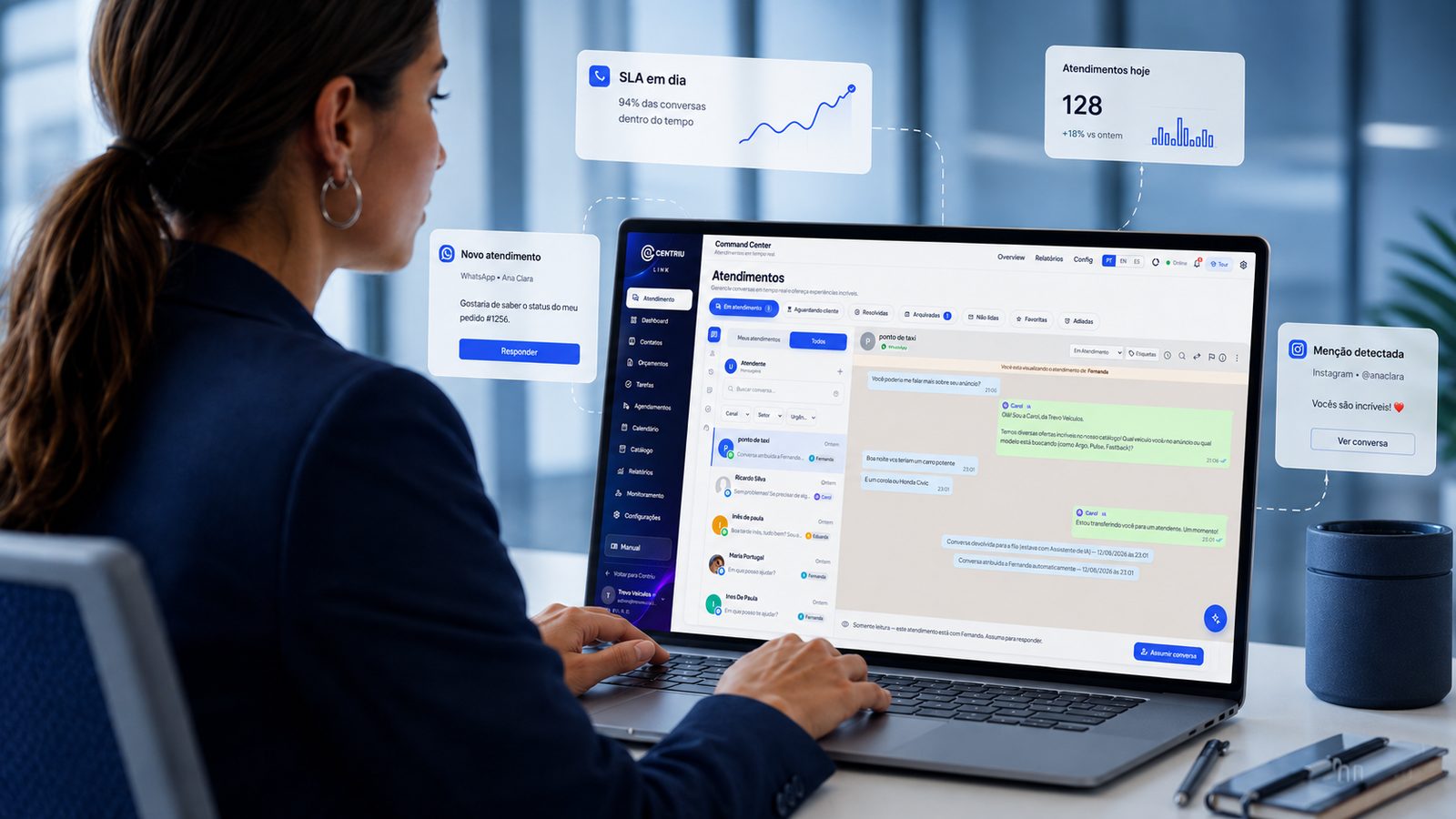
Vendas, marketing, atendimento, operação, financeiro e inteligência trabalhando sobre o mesmo contexto — para sua empresa ganhar escala sem perder controle.
Sua empresa inteira. Uma operação. IA trabalhando.
Para empresas de qualquer setor que querem crescer com estrutura, controle e inteligência.
Painel ilustrativo do Sistema Centriu com sete frentes trabalhando: atendimento, comercial, operação, agentes, inteligência, conteúdo e marketing. Cada frente mostra o trabalho concluído ou o próximo passo.
Representação ilustrativa do trabalho em execução
Não é falta de ferramenta. É que cada ferramenta resolve um pedaço, e ninguém é dono do todo. O custo disso não aparece numa fatura — aparece no mês seguinte.
Sistemas que não se falam
O mesmo dado é digitado de novo — e cada cópia conta uma história diferente.
Dados duplicados
Ninguém sabe qual versão é a verdadeira na hora de decidir.
Conversas perdidas
O cliente repete o contexto a cada canal e a cada pessoa.
Tarefas espalhadas
O trabalho vive em planilhas, mensagens e na memória de alguém.
Decisões sem contexto
A escolha é feita com o recorte que estava à mão, não com o que importava.
Automações desconectadas
Cada ferramenta automatiza um pedaço e ninguém enxerga o todo.
Nenhum desses problemas se resolve comprando mais um software. Eles se resolvem quando a operação inteira passa a trabalhar sobre o mesmo contexto.
A Centriu não é uma coleção de produtos. É uma plataforma em que clientes, áreas e agentes leem e escrevem no mesmo lugar.
Cliente 360
Um contexto, não vários cadastros
Cada conversa, tarefa, campanha, cobrança e decisão fica ligada ao cliente e à operação — não a um sistema isolado.
As áreas abaixo são partes da mesma operação, não produtos separados. Elas compartilham conta, permissões e histórico.
A inteligência artificial da Centriu participa da operação: entende contexto, prepara trabalho, executa rotinas e pede aprovação quando importa.
Lê a operação, o cliente e o histórico antes de propor qualquer coisa.
Redige, organiza, calcula e deixa pronto para revisão humana.
Roda o que é repetitivo dentro dos limites definidos pela empresa.
Cruza áreas, identifica prioridade e mostra o motivo da recomendação.
O que é sensível passa por uma pessoa antes de valer. Sem exceção silenciosa.
Registra o que aconteceu e usa o resultado para melhorar a próxima decisão.
Uma plataforma, várias frentes de trabalho. Tudo no mesmo contexto, com a IA participando do que dá para acelerar.
CRM, pipeline, oportunidades, propostas, follow-up e automações.
WhatsApp, Instagram, Messenger, chat do site e e-mail no mesmo contexto.
Tarefas, responsáveis, prazos, aprovações, agenda e capacidade.
Contas, cobranças, caixa, fiscal, margem, IR, orçamento e inteligência econômica.
Planejar, produzir, aprovar, publicar e medir conteúdo e campanhas.
Painéis, alertas, previsões, recomendações e leitura executiva.
Rotinas executadas continuamente pela IA com controle e aprovação.
Diagnóstico, estratégia, transformação, acompanhamento e especialistas.
A Centriu faz sentido quando o volume aumenta e a estrutura precisa acompanhar. Não é sobre setor nem tamanho: é sobre a operação conseguir sustentar o próximo estágio.
As vendas crescem, mas o processo não acompanha.
As áreas trabalham separadas e o cliente sente.
A operação depende de pessoas específicas.
O financeiro ficou complexo e o caixa perde visibilidade.
O atendimento cresce em volume e em canais.
A IA entra sem contexto, controle ou histórico.
Se a empresa ainda não começou a crescer, a Centriu também ajuda a preparar a estrutura para o primeiro salto.
Ver a Centriu funcionandoA Centriu combina tecnologia, inteligência, método e acompanhamento. A consultoria diagnostica, desenha, implanta e acompanha — com evidências, não com apresentação.
Diagnóstico e imersão na operação
Estratégia e prioridades
Roadmap de transformação
Desenho da arquitetura operacional
Implantação conduzida
Acompanhamento com evidências
Benchmarking e leitura de mercado
Especialistas, rede e inteligência coletiva
Uma conversa para entender onde a sua operação perde tempo, dinheiro ou capacidade — e o que a Centriu faria primeiro.
problema
"The project might be delayed" feels like a risk statement. But it names nothing a team could act on: not why it might happen, not what would occur, not what it would cost. Centriu Oracle checks every risk statement for three parts — a cause, an uncertain event, and a consequence. It also scans the text against seven vague phrases that are inadequate. This includes the delay example. It checks three patterns that blame a person or team instead of describing a verifiable condition. A second check reads the same text for tense and modality. Something written in the present tense ("is already happening") gets redirected to the diagnosis as a current problem. An assumption gets redirected to the plan's stated premises. A known budget ceiling gets redirected to constraints. A "depends on" statement gets redirected to dependencies. A future risk register that fills up with present-tense problems and unstated assumptions is not a reliable picture of what could go wrong.
A risk register invites whatever a consultant is worried about when they open it. Under that pressure, three kinds of entries blur together: a genuine future uncertainty, a current problem, and an assumption treated as a fact. Each needs a different response. A risk needs a probability and a plan. A current problem needs a diagnosis and a fix. An assumption needs to be tested before it is relied on. But nothing about a blank text field stops them from landing in the same list, worded the same way, with the same urgency.
A risk register invites whatever a consultant is worried about when they open it. Under that pressure, three kinds of entries blur together: a genuine future uncertainty, a current problem, and an assumption treated as a fact. Each needs a different response. A risk needs a probability and a plan. A current problem needs a diagnosis and a fix. An assumption needs to be tested before it is relied on. But nothing about a blank text field stops them from landing in the same list, worded the same way, with the same urgency.
Every risk statement is checked for three parts — a cause ("why might this happen"), an uncertain event ("what could occur"), and a consequence ("what does it cause, and to whom"). Each needs a minimum length to count as present. Missing all three scores the statement "vague." Missing some scores it "partial." Only a statement with a cause, event, and consequence scores "adequate." The text is checked against seven vague-phrasing patterns that are inadequate. This includes the "the project might be delayed" example. It also checks three patterns that blame a person or team instead of describing a condition anyone could verify. A second classifier reads the same text for tense and modality markers. Present-tense language ("is already happening," "has been since [month]," "recurringly") redirects the entry to the diagnosis as a current problem. "We don't know" or "it's unclear" language redirects it to critical uncertainties. "Assuming that" language redirects it to the plan's premises. A declared budget ceiling redirects it to constraints. "Depends on" language redirects it to dependencies. Each redirect names where the entry belongs and why, not just rejecting it. For numbers, any probability rated above "moderate" is capped back to "moderate" unless a basis exists. This includes a named source, a rationale, linked evidence, or a linked signal. The rating "imminent" requires an observed signal, downgrading to "very high" without one. Every financial estimate is checked for a formula, source, assumptions, time period, and limitations. A single point value with no low-high range is flagged and presented with a hedge instead of as a bare number.
A three-part check (cause, uncertain event, consequence) that scores every risk statement vague, partial, or adequate. This runs live as the consultant types in the risk-creation dialog, not only on final submission.
Seven vague-phrasing patterns and three blame-attribution patterns checked against the risk text. This matches the inadequate examples the methodology names.
A tense-and-modality classifier that redirects a present-tense problem, an information gap, an assumption, a known constraint, or a dependency away from the risk register. It goes to the correct destination with a reason for every redirect.
A probability-basis requirement: any rating above "moderate" is capped back to "moderate" without a source, rationale, evidence, or signal. "Imminent" requires an observed signal.
A five-part structure on every numeric estimate (formula, source, assumptions, period, limitations). A missing low-high range is flagged and hedged in the generated text instead of shown as a bare number.
The same classification logic runs on save and in the creation dialog. A consultant sees the same verdict while typing that the server would enforce on submission.
A risk register stops absorbing present-tense problems, untested assumptions, and vague worry statements that nobody could act on. A probability rating carries a checkable reason instead of just a feeling. This is especially true at the top of the scale, where the language justifies urgent client conversations. A numeric estimate is never handed to a client as more precise than the data supports.
A risk register stops absorbing present-tense problems, untested assumptions, and vague worry statements that nobody could act on. A probability rating carries a checkable reason instead of just a feeling. This is especially true at the top of the scale, where the language justifies urgent client conversations. A numeric estimate is never handed to a client as more precise than the data supports.
A consultant types three notes during a client call. The first — "sales could drop if the main competitor launches a promotion, cutting this quarter's revenue by a meaningful margin" — is accepted as a well-formed risk. It names a cause (a competitor promotion), an uncertain event (a sales drop), and a consequence (reduced revenue). The second — "we are already losing about three days per approval cycle" — is flagged as a present-tense problem. It is redirected to the diagnosis with an explanation. The third — "assuming the new pricing page ships by month-end" — is redirected to the plan's premises. It describes a condition assumed true for planning, not something uncertain that might occur.
A cause (why it might happen), an uncertain event (what could occur), and a consequence (what it causes, and to whom). Missing all three scores the statement "vague"; missing some scores it "partial."
No. It saves the entry, scores its quality, and explains what is missing or which vague/blame pattern was matched. It never drops what a consultant wrote.
A tense-and-modality classifier reads for present-tense language. It redirects the entry to the diagnosis as a current problem, explaining why.
No. "Imminent" requires at least one recorded anticipatory signal. Without one, the rating is downgraded to "very high" with a reason.
It is flagged with an alert and presented with a hedge in the text. A bare number without formula, source, or a low-high range is never shown as a guaranteed value.
It is sold by subscription with a starting price. Exact current values are on the pricing page.
"The project might be delayed" feels like a risk statement. But it names nothing a team could act on: not why it might happen, not what would occur, not what it would cost. Centriu Oracle checks every risk statement for three parts — a cause, an uncertain event, and a consequence. It scans the text against seven vague phrases that are inadequate. This includes the delay example. It checks three patterns that blame a person or team instead of describing a verifiable condition. A second check reads the same text for tense and modality. Something written in the present tense ("is already happening") gets redirected to the diagnosis as a current problem. An assumption gets redirected to the plan's premises. A known budget ceiling gets redirected to constraints. A "depends on" statement gets redirected to dependencies. A future risk register that fills up with present-tense problems and unstated assumptions is not a reliable picture of what could go wrong.