
Entende o contexto
Lê a operação, o cliente e o histórico antes de propor qualquer coisa.
Vendas, marketing, atendimento, operação, financeiro e inteligência trabalhando sobre o mesmo contexto — para sua empresa ganhar escala sem perder controle.
Sua empresa inteira. Uma operação. IA trabalhando.
Para empresas de qualquer setor que querem crescer com estrutura, controle e inteligência.
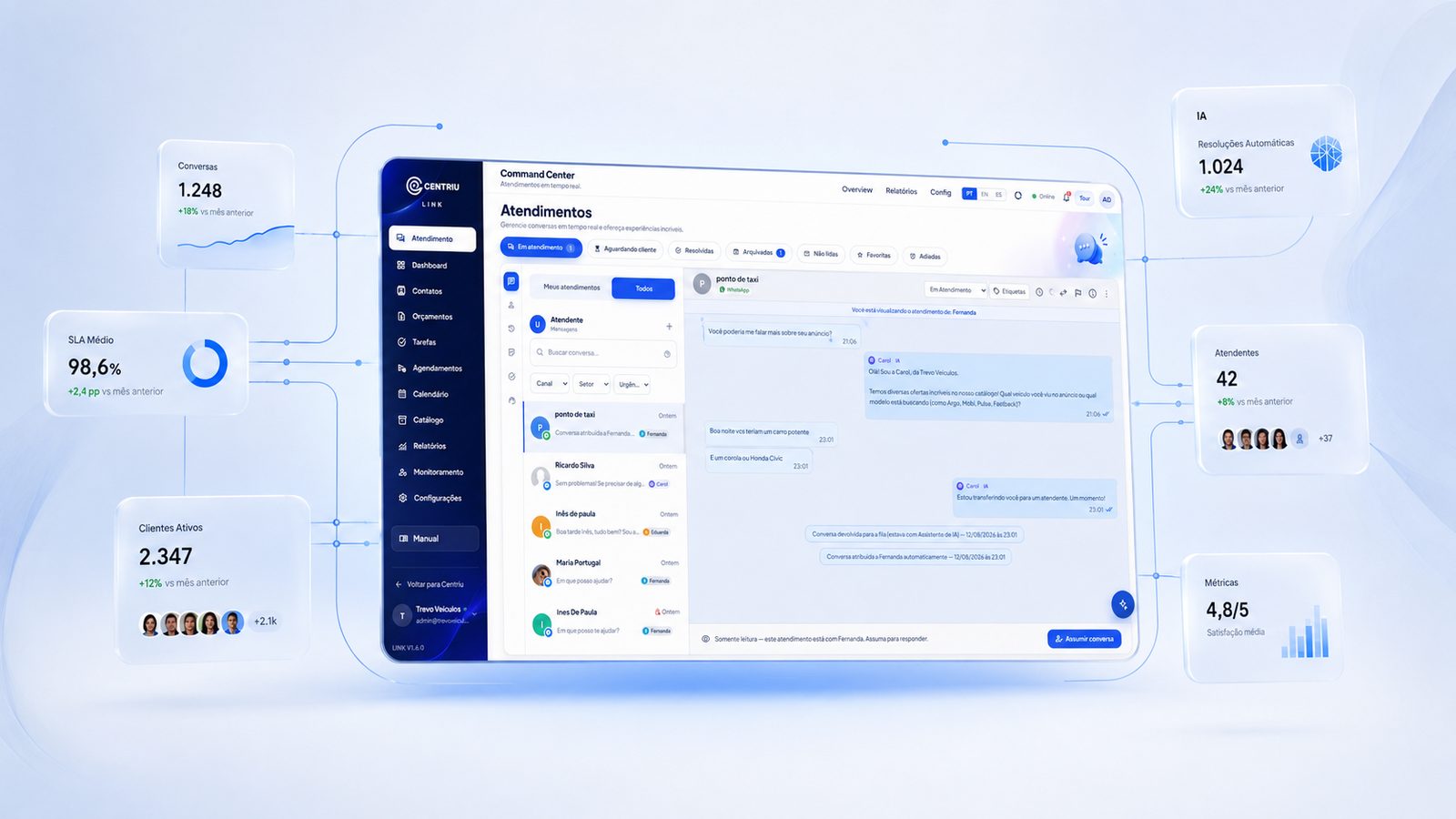
Painel ilustrativo do Sistema Centriu com sete frentes trabalhando: atendimento, comercial, operação, agentes, inteligência, conteúdo e marketing. Cada frente mostra o trabalho concluído ou o próximo passo.
Representação ilustrativa do trabalho em execução
Não é falta de ferramenta. É que cada ferramenta resolve um pedaço, e ninguém é dono do todo. O custo disso não aparece numa fatura — aparece no mês seguinte.
Sistemas que não se falam
O mesmo dado é digitado de novo — e cada cópia conta uma história diferente.
Dados duplicados
Ninguém sabe qual versão é a verdadeira na hora de decidir.
Conversas perdidas
O cliente repete o contexto a cada canal e a cada pessoa.
Tarefas espalhadas
O trabalho vive em planilhas, mensagens e na memória de alguém.
Decisões sem contexto
A escolha é feita com o recorte que estava à mão, não com o que importava.
Automações desconectadas
Cada ferramenta automatiza um pedaço e ninguém enxerga o todo.
Nenhum desses problemas se resolve comprando mais um software. Eles se resolvem quando a operação inteira passa a trabalhar sobre o mesmo contexto.
A Centriu não é uma coleção de produtos. É uma plataforma em que clientes, áreas e agentes leem e escrevem no mesmo lugar.
Cliente 360
Um contexto, não vários cadastros
Cada conversa, tarefa, campanha, cobrança e decisão fica ligada ao cliente e à operação — não a um sistema isolado.
As áreas abaixo são partes da mesma operação, não produtos separados. Elas compartilham conta, permissões e histórico.
A inteligência artificial da Centriu participa da operação: entende contexto, prepara trabalho, executa rotinas e pede aprovação quando importa.
Lê a operação, o cliente e o histórico antes de propor qualquer coisa.
Redige, organiza, calcula e deixa pronto para revisão humana.
Roda o que é repetitivo dentro dos limites definidos pela empresa.
Cruza áreas, identifica prioridade e mostra o motivo da recomendação.
O que é sensível passa por uma pessoa antes de valer. Sem exceção silenciosa.
Registra o que aconteceu e usa o resultado para melhorar a próxima decisão.
Uma plataforma, várias frentes de trabalho. Tudo no mesmo contexto, com a IA participando do que dá para acelerar.
CRM, pipeline, oportunidades, propostas, follow-up e automações.
WhatsApp, Instagram, Messenger, chat do site e e-mail no mesmo contexto.
Tarefas, responsáveis, prazos, aprovações, agenda e capacidade.
Contas, cobranças, caixa, fiscal, margem, IR, orçamento e inteligência econômica.
Planejar, produzir, aprovar, publicar e medir conteúdo e campanhas.
Painéis, alertas, previsões, recomendações e leitura executiva.
Rotinas executadas continuamente pela IA com controle e aprovação.
Diagnóstico, estratégia, transformação, acompanhamento e especialistas.
A Centriu faz sentido quando o volume aumenta e a estrutura precisa acompanhar. Não é sobre setor nem tamanho: é sobre a operação conseguir sustentar o próximo estágio.
As vendas crescem, mas o processo não acompanha.
As áreas trabalham separadas e o cliente sente.
A operação depende de pessoas específicas.
O financeiro ficou complexo e o caixa perde visibilidade.
O atendimento cresce em volume e em canais.
A IA entra sem contexto, controle ou histórico.
Se a empresa ainda não começou a crescer, a Centriu também ajuda a preparar a estrutura para o primeiro salto.
Ver a Centriu funcionandoA Centriu combina tecnologia, inteligência, método e acompanhamento. A consultoria diagnostica, desenha, implanta e acompanha — com evidências, não com apresentação.
Diagnóstico e imersão na operação
Estratégia e prioridades
Roadmap de transformação
Desenho da arquitetura operacional
Implantação conduzida
Acompanhamento com evidências
Benchmarking e leitura de mercado
Especialistas, rede e inteligência coletiva
Uma conversa para entender onde a sua operação perde tempo, dinheiro ou capacidade — e o que a Centriu faria primeiro.
problema
Sales pipeline automation, through Centriu Orbit, is a Kanban-based CRM. It is built around one rule: no opportunity moves through a pipeline without an owner and a defined next step. Orbit runs multiple pipelines at once. It applies per-stage quality gates that the board checks before a deal is dragged into the next column. This is an on-screen check, not a database rule. It surfaces a dedicated list of exactly what has stalled. So the sales lead’s first question every morning ("what fell through the cracks?") already has an answer on screen.

A sales pipeline is only as trustworthy as its weakest link. The weakest link is almost always the same one. It is a deal that quietly stops moving. This happens because nobody was clearly responsible for the next action. A spreadsheet or a generic Kanban board can show you the stages. But nothing stops a card from sitting in "negotiation" for six weeks. Everyone assumes someone else is handling it.
Centriu Orbit is built around closing that specific gap. Every deal card carries an owner and a next step as first-class fields, not optional notes. The system runs on multiple pipelines at once. So a team selling more than one product or service line does not have to force everything into a single funnel that fits none of them well.
Orbit runs a Kanban board across multiple pipelines. So different products, services or sales motions each get their own funnel. They are not forced into one. Quality gates sit between stages. So a deal cannot be dragged forward on the board without meeting what the team has defined as ready for that step. This is a check made in the interface. Editing a deal or marking it won or lost does not pass through it.
A dedicated stalled-deal list surfaces exactly which opportunities have gone quiet. It does not require someone to scroll the whole board looking for the ones that stopped moving. Every card in the system carries a clear owner and a defined next step. These are the two fields Orbit treats as not optional.
Kanban board supporting multiple pipelines at the same time for different products, services or sales motions.
Quality gates between stages that the Kanban board checks before a deal is dragged forward.
A dedicated, always-current list of stalled deals. No manual scrolling is needed to find what went quiet.
A required owner and next step on every deal card.
The structural change is that "no owner, no next step" stops being possible. It is not just a policy people try to remember. Stalled deals become visible on a dedicated list. They do not hide in plain sight on a crowded board. A drag to the next stage on the board means something. This is because the stage requirement was checked first. What that is worth in closed revenue depends entirely on a team’s own pipeline and conversion rates. Centriu does not attach a projected uplift number that would hold true across different sales teams.
The structural change is that "no owner, no next step" stops being possible. It is not just a policy people try to remember. Stalled deals become visible on a dedicated list. They do not hide in plain sight on a crowded board. A drag to the next stage on the board means something. This is because the stage requirement was checked first. What that is worth in closed revenue depends entirely on a team’s own pipeline and conversion rates. Centriu does not attach a projected uplift number that would hold true across different sales teams.
The sales lead opens Orbit before the team stand-up. They check the stalled-deal list first. Three opportunities have not moved in the defined time. One is a deal stuck at the quality gate between "demo done" and "proposal sent." This is because the qualification checklist was never completed. The board refused to drag it forward. So the gap was visible instead of hidden behind a false sense of progress.
A second pipeline runs at the same time. This is for the reseller’s renewal business. This is a completely different sales motion from new-logo sales. It shows a renewal conversation sitting on the no-next-step list. The rep sees it before the customer has to reach out first.
By the stand-up, every open deal in both pipelines already has a name and a next action attached to it. This is because the board would not let it exist otherwise.
Yes. Multiple pipelines can run at the same time. This is useful when a team sells more than one product or service line with truly different sales motions.
This is a requirement the team sets for a stage. The Kanban board and the deal drawer check it before a deal moves forward. The check runs in the interface, not in the database. So editing a deal or marking it won or lost does not go through it.
Through a dedicated stalled-deal list. It is kept current automatically. It does not require someone to manually scan the whole board for cards that stopped moving.
Yes. Orbit treats owner and next step as required fields on every opportunity. This is by design, not as optional notes.
No. Orbit is the pipeline layer for sales specifically. Broader marketing and cross-department automation is Centriu Flow’s territory.
It is sold by subscription. It starts at a published entry price, with tiered plans. Exact current values are on the central pricing page. They are never restated here.
Sales pipeline automation, through Centriu Orbit, is a Kanban-based CRM. It is built around one rule: no opportunity moves through a pipeline without an owner and a defined next step. Orbit runs multiple pipelines at once. It applies per-stage quality gates that the board checks before a deal is dragged into the next column. This is an on-screen check, not a database rule. It surfaces a dedicated list of exactly what has stalled. So the sales lead’s first question every morning ("what fell through the cracks?") already has an answer on screen.