
Entende o contexto
Lê a operação, o cliente e o histórico antes de propor qualquer coisa.
Vendas, marketing, atendimento, operação, financeiro e inteligência trabalhando sobre o mesmo contexto — para sua empresa ganhar escala sem perder controle.
Sua empresa inteira. Uma operação. IA trabalhando.
Para empresas de qualquer setor que querem crescer com estrutura, controle e inteligência.
Painel ilustrativo do Sistema Centriu com sete frentes trabalhando: atendimento, comercial, operação, agentes, inteligência, conteúdo e marketing. Cada frente mostra o trabalho concluído ou o próximo passo.
Representação ilustrativa do trabalho em execução
Não é falta de ferramenta. É que cada ferramenta resolve um pedaço, e ninguém é dono do todo. O custo disso não aparece numa fatura — aparece no mês seguinte.
Sistemas que não se falam
O mesmo dado é digitado de novo — e cada cópia conta uma história diferente.
Dados duplicados
Ninguém sabe qual versão é a verdadeira na hora de decidir.
Conversas perdidas
O cliente repete o contexto a cada canal e a cada pessoa.
Tarefas espalhadas
O trabalho vive em planilhas, mensagens e na memória de alguém.
Decisões sem contexto
A escolha é feita com o recorte que estava à mão, não com o que importava.
Automações desconectadas
Cada ferramenta automatiza um pedaço e ninguém enxerga o todo.
Nenhum desses problemas se resolve comprando mais um software. Eles se resolvem quando a operação inteira passa a trabalhar sobre o mesmo contexto.
A Centriu não é uma coleção de produtos. É uma plataforma em que clientes, áreas e agentes leem e escrevem no mesmo lugar.
Cliente 360
Um contexto, não vários cadastros
Cada conversa, tarefa, campanha, cobrança e decisão fica ligada ao cliente e à operação — não a um sistema isolado.
As áreas abaixo são partes da mesma operação, não produtos separados. Elas compartilham conta, permissões e histórico.
A inteligência artificial da Centriu participa da operação: entende contexto, prepara trabalho, executa rotinas e pede aprovação quando importa.
Lê a operação, o cliente e o histórico antes de propor qualquer coisa.
Redige, organiza, calcula e deixa pronto para revisão humana.
Roda o que é repetitivo dentro dos limites definidos pela empresa.
Cruza áreas, identifica prioridade e mostra o motivo da recomendação.
O que é sensível passa por uma pessoa antes de valer. Sem exceção silenciosa.
Registra o que aconteceu e usa o resultado para melhorar a próxima decisão.
Uma plataforma, várias frentes de trabalho. Tudo no mesmo contexto, com a IA participando do que dá para acelerar.
CRM, pipeline, oportunidades, propostas, follow-up e automações.
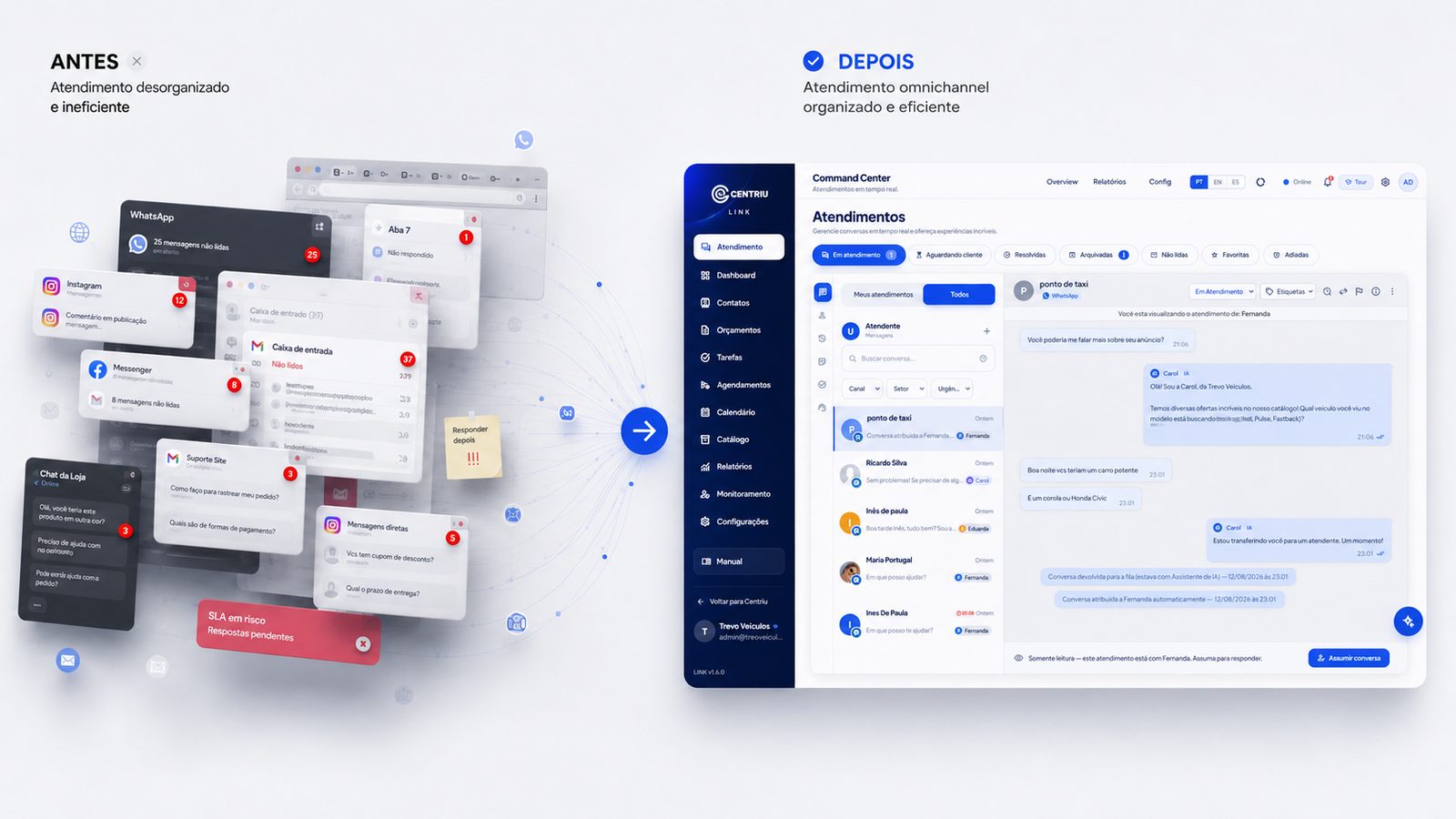
WhatsApp, Instagram, Messenger, chat do site e e-mail no mesmo contexto.
Tarefas, responsáveis, prazos, aprovações, agenda e capacidade.
Contas, cobranças, caixa, fiscal, margem, IR, orçamento e inteligência econômica.
Planejar, produzir, aprovar, publicar e medir conteúdo e campanhas.
Painéis, alertas, previsões, recomendações e leitura executiva.
Rotinas executadas continuamente pela IA com controle e aprovação.
Diagnóstico, estratégia, transformação, acompanhamento e especialistas.
A Centriu faz sentido quando o volume aumenta e a estrutura precisa acompanhar. Não é sobre setor nem tamanho: é sobre a operação conseguir sustentar o próximo estágio.
As vendas crescem, mas o processo não acompanha.
As áreas trabalham separadas e o cliente sente.
A operação depende de pessoas específicas.
O financeiro ficou complexo e o caixa perde visibilidade.
O atendimento cresce em volume e em canais.
A IA entra sem contexto, controle ou histórico.
Se a empresa ainda não começou a crescer, a Centriu também ajuda a preparar a estrutura para o primeiro salto.
Ver a Centriu funcionandoA Centriu combina tecnologia, inteligência, método e acompanhamento. A consultoria diagnostica, desenha, implanta e acompanha — com evidências, não com apresentação.
Diagnóstico e imersão na operação
Estratégia e prioridades
Roadmap de transformação
Desenho da arquitetura operacional
Implantação conduzida
Acompanhamento com evidências
Benchmarking e leitura de mercado
Especialistas, rede e inteligência coletiva
Uma conversa para entender onde a sua operação perde tempo, dinheiro ou capacidade — e o que a Centriu faria primeiro.
problema
The most dangerous reading of a shadow-AI discovery tool is "nothing showed up, so nothing is happening" — and Centriu TrustOps is built specifically to refuse that reading. Every detection carries real, registered evidence — its source, date, detection method, the rule that fired, a confidence tier and a risk classification — moving through a deterministic pipeline with no generative AI making the call: the engine classifies, scores and queues; a human always decides. Eight of twenty discovery surfaces work today through an authenticated API; the rest are marked honestly as not yet collecting, each with the specific missing piece named. A dedicated coverage page exists for one reason: to make sure an empty queue is read as "not measured here" rather than "confirmed safe."
Every AI governance conversation eventually runs into the same false comfort: a company inventories the AI tools it knows about, secures those, and treats the exercise as complete. The actual risk was never in the tools that got inventoried — it is in the ones nobody registered: a free AI writing assistant an employee found on their own, a personal account used to paste a client document into a chatbot, an old API key still calling a model the organization has since banned. A discovery tool that only shows something when it catches an obvious case is worse than no tool at all, because it converts a real unknown into a false confidence.
Every AI governance conversation eventually runs into the same false comfort: a company inventories the AI tools it knows about, secures those, and treats the exercise as complete. The actual risk was never in the tools that got inventoried — it is in the ones nobody registered: a free AI writing assistant an employee found on their own, a personal account used to paste a client document into a chatbot, an old API key still calling a model the organization has since banned. A discovery tool that only shows something when it catches an obvious case is worse than no tool at all, because it converts a real unknown into a false confidence.
Evidence moves through a fixed, deterministic pipeline — collection, validation, normalization, correlation, classification, scoring, case, human decision, record — with no generative AI at any step and no automatic blocking: the engine classifies, scores and organizes the queue, and the decision is always a person's, recorded and auditable. Every piece of evidence is tagged with one of three honest confidence tiers: observed (evidence seen directly from the source), inferred (an indirect signal, such as a DNS resolution for the domain), or suspected (a weak signal on its own). A detection resolves into one of eight real outcomes — confirmed, false positive, already registered, temporarily ignored, exception granted, mitigated, converted to an asset, or closed — and none of that classification is left implicit. The evidence model itself has no column for prompt content, typed text, passwords, tokens, generated responses or full documents — not a policy choice enforced by application logic, but the literal absence of anywhere to put that data, confirmed at the schema level. A dedicated coverage page names exactly what is and is not being watched, and an automated test permanently forbids the page from ever claiming "total coverage," "100%," "guaranteed" or "zero risk" in any scenario, including one where every possible source is active; when no source is configured, the page states outright that an absence of detections does not mean an absence of usage. Twenty discovery surfaces are declared with the same honesty: eight work today through an authenticated ingestion API (api, gateway, proxy, dns, firewall, sso, expenses, sdk), three work through manual registration in the interface (manual, report, vendors), and nine are modeled but have no real connector yet (csv, xlsx, webhook, extension, casb, oauth, integration, code repository, endpoint) — each pending surface is required to declare, specifically, the technical dependency still missing, and no pending source is allowed to generate a synthetic event that could be mistaken for a real one. Ingestion itself is hardened: access tokens are never stored, only their hash; the organization a detection is attributed to is derived from the credential on the server side and cannot be overridden by anything the calling source sends, confirmed by testing a forged organization ID against another organization's credential and watching it write to the correct organization anyway; duplicate submissions are rejected by an idempotency key; timestamps too far in the future or too far in the past are rejected outright; and both request size and batch size are capped.
A deterministic, no-generative-AI pipeline: collection, validation, normalization, correlation, classification, scoring, case creation, human decision, and record — identical input always produces identical output.
Three honest confidence tiers per piece of evidence — observed, inferred, suspected — and eight real case outcomes, from confirmed through false positive to converted-to-asset or closed.
A schema with no column for prompt content, typed text, passwords, tokens, generated responses or full documents — sensitive content has nowhere to be stored, by design, not by policy.
A dedicated coverage page naming exactly what is watched and what is not, with an automated test permanently forbidding "total coverage," "100%," "guaranteed" or "zero risk" claims.
Eight discovery surfaces working today through an authenticated ingestion API, three through manual registration, and nine honestly declared as modeled with no real connector yet, each naming its specific missing dependency.
Eleven built-in deterministic detection rules — unregistered AI tools, personal-account usage of AI tools, shared credentials, prohibited or deprecated models in use, unregistered agents, and more — each with its own real trigger condition.
Hardened ingestion: hashed-only token storage, server-derived organization attribution immune to a forged value in the request, idempotency, anti-replay timestamp checks, and request/batch size limits.
Sixteen granular permissions gating who can view, view sensitive evidence specifically, manage sources or rules, triage, confirm, dismiss, create an asset or exception, export, or manage retention.
Evidence marked sensitive is visible as existing to anyone with view access, but its actual content is restricted to those holding the separate view_sensitive permission.
The structural change is that "we haven't seen anything" stops being treated as equivalent to "there is nothing to see." Detections carry the evidence, the confidence and the specific rule that fired, so triage does not start from a hunch. The coverage page keeps the tool's own limits visible rather than letting a clean queue quietly imply more safety than the collection actually supports. Centriu attaches no figure to what this prevents; it depends entirely on how much of an organization's AI usage was genuinely unregistered.
The structural change is that "we haven't seen anything" stops being treated as equivalent to "there is nothing to see." Detections carry the evidence, the confidence and the specific rule that fired, so triage does not start from a hunch. The coverage page keeps the tool's own limits visible rather than letting a clean queue quietly imply more safety than the collection actually supports. Centriu attaches no figure to what this prevents; it depends entirely on how much of an organization's AI usage was genuinely unregistered.
A security lead opens the discovery queue after a quiet month and, before trusting the silence, checks the coverage page first. It shows plainly that eight surfaces are actively collecting — including the corporate SSO and the expense-report feed — and that browser-based usage, the single largest source of shadow AI in most organizations, has no connector yet; the page states this explicitly as a declared gap, not as a working feature.
A week later, the expense-report surface flags a recurring charge to a known AI tool vendor with no corresponding entry in the AI asset inventory. The unregistered_ai_tool rule fires with an "inferred" confidence tier — the signal is indirect, a billing line item, not a direct observation of usage — and a case opens. Triage confirms it: a team had quietly adopted the tool three months earlier without registering it. The detection converts to a registered asset, closing the case with the trail of exactly how it was found.
Meanwhile, a second alert — a personal Gmail address authenticating to a known AI chatbot from a corporate network — carries an "observed" tier, a stronger signal. A reviewer with view_sensitive access opens the underlying evidence; a colleague without that permission sees only that a detection exists, not its content.

No — the coverage page states this explicitly. An empty queue reflects what the currently connected surfaces can see; it is not proof that nothing unregistered is happening elsewhere.
No. The pipeline is fully deterministic — no generative AI is involved in classifying, scoring or deciding. A human reviews every case and makes the final call.
Three: observed (evidence seen directly), inferred (an indirect signal, such as a DNS resolution), and suspected (a weak signal alone) — never a single undifferentiated "detected."
No — the schema has no column for prompt content, typed text, passwords, tokens, generated responses or full documents. That data has nowhere to be stored, by design.
Eight of twenty work today through an authenticated ingestion API, three work by manual registration, and nine are honestly declared as modeled with no real connector implemented yet.
Not yet — it runs on demand today, triggered from the interface. The scheduled-worker infrastructure exists in the database but nothing currently calls it automatically.
It is sold by subscription with a published starting price — exact current values are on the central pricing page.
The most dangerous reading of a shadow-AI discovery tool is "nothing showed up, so nothing is happening" — and Centriu TrustOps is built specifically to refuse that reading. Every detection carries real, registered evidence — its source, date, detection method, the rule that fired, a confidence tier and a risk classification — moving through a deterministic pipeline with no generative AI making the call: the engine classifies, scores and queues; a human always decides. Eight of twenty discovery surfaces work today through an authenticated API; the rest are marked honestly as not yet collecting, each with the specific missing piece named. A dedicated coverage page exists for one reason: to make sure an empty queue is read as "not measured here" rather than "confirmed safe."